Yes — Essaouira is safe for visitors, and it is one of the easiest cities in Morocco to arrive in cold. It is small, walkable, walled, and used to travellers; violent crime against tourists is rare, and most of what goes wrong here is a bill that grew, a “guide” you never asked for, or a walk taken too far down an empty beach at dusk.
That is the honest verdict. The rest of this guide is the detail that actually helps: which neighbourhoods to book, which ones to leave by taxi after dark, the specific scams you will meet in this specific town, how the taxis work, what changes at night, what solo travellers and solo women really experience here, and the three numbers to save in your phone before you land.
The short answer
Safe, small and unusually relaxed by Moroccan city standards — the medina is comfortable to walk day and night, the hassle is verbal rather than physical, and the two real risks are opportunistic pickpocketing in crowds and empty stretches of beach and dune south of town. Treat it like any small port city and you will be fine.
Essaouira has a different temperature to Marrakech or Fes. The medina is compact and laid out on a grid — the Portuguese built it that way — so getting lost is a five-minute inconvenience, not an ordeal. The souks are working markets more than tourist funnels. Shopkeepers call out, but they take no for an answer faster than they do inland, and by day three the man who sells fruit on your corner will greet you by sight.
What that does not mean is that nothing happens. Bags get opened in the crush around Souk Jdid on a busy morning. Phones vanish from café tables at Place Moulay Hassan. People walking the long beach south towards the river mouth alone, at the wrong hour, have been followed and robbed. None of this is unique to Morocco — it is what happens in every coastal town with a lot of visitors and a lot of empty ground just outside it. If you want the national picture first, our guide on whether Morocco is safe for tourists covers the country as a whole; this page is Essaouira specifically. And if you are here for the museums, the ramparts and the argan road rather than the risk assessment, our Essaouira travel guide is the things-to-see page.
Staying connected in Essaouira
The single most useful safety tool you will carry here is a phone that works the moment you land. Not for emergencies — for the ordinary things. Pulling up the walking route back to your riad when the lane you took looks unfamiliar. Showing a taxi driver the pin instead of arguing about an address. Messaging your riad that you are ten minutes away. Calling 19 without first hunting for wifi.
Moroccan roaming on a home contract is unpredictable and often expensive, and hotel wifi stops at the door. A Morocco eSIM is the simplest fix: you pick your trip length, it arrives as a QR code by email before you fly, and it connects itself when you land — unlimited data, two hours of calls, support around the clock. No shop queue, no passport registration, no swapping the SIM you need for your bank’s verification codes. If eSIMs are new to you, here is what an eSIM actually is. Set it up on the sofa at home, not in the arrivals hall.
Where to stay, and where to be careful
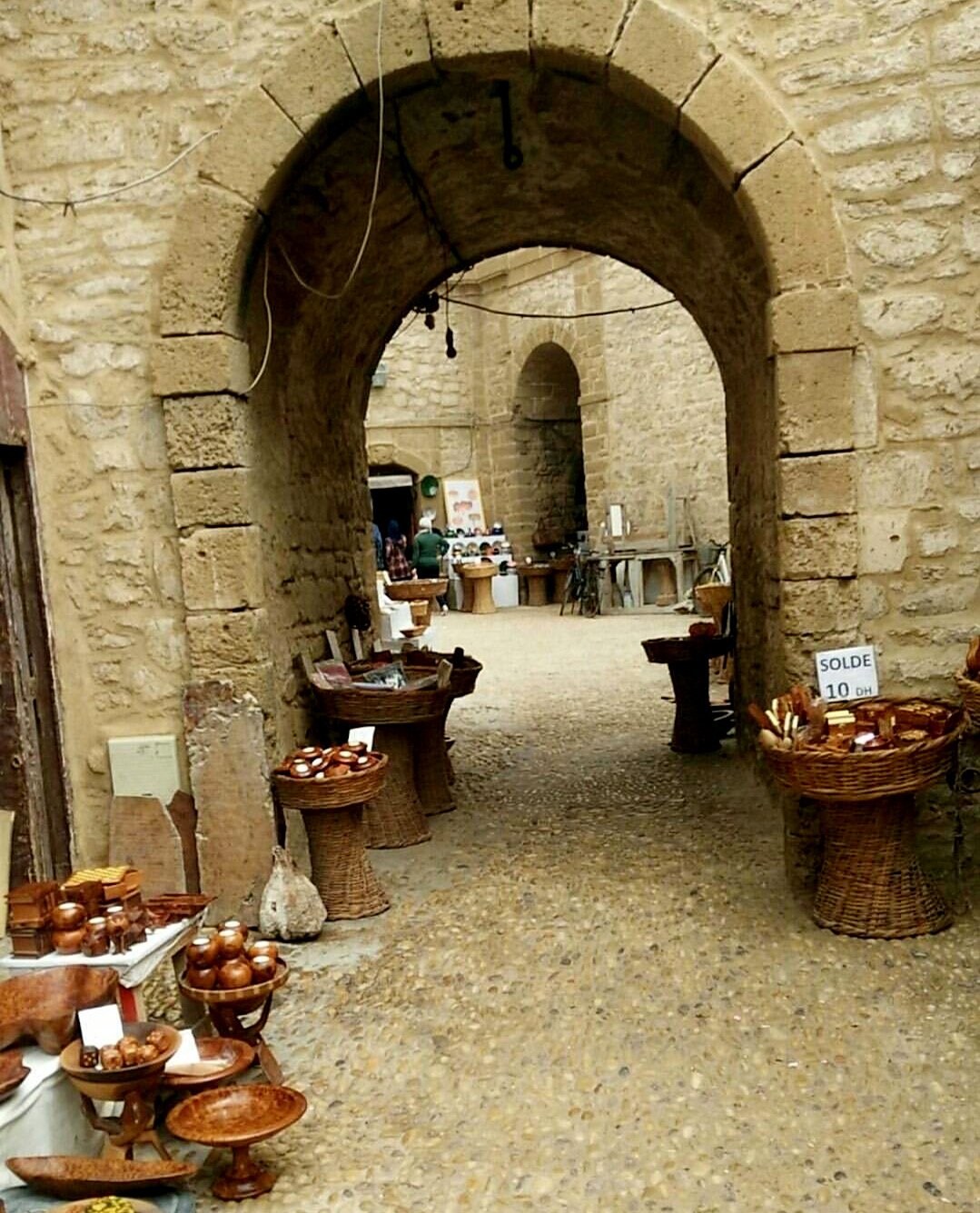
Almost every visitor should stay inside the medina walls, and almost every visitor does. The walled town is where the riads, the restaurants and the life are, it is closed to through traffic, and it is lit and populated late. Book inside the walls and you have solved most of this section already. But Essaouira is not uniformly the same after dark, and a few named areas are worth understanding before you click confirm.
The main medina arteries — Avenue de l’Istiqlal, Rue Mohamed El Qorry, Rue Sidi Mohamed Ben Abdallah and the Souk Jdid crossroads — plus Place Moulay Hassan and the Kasbah quarter around it. Also the seafront strip on Avenue Mohammed V and the newer Quartier Borj behind the beach, which is residential, flat, lit and full of ordinary pharmacies and cafés. These are the streets to book on and the streets to walk home along.
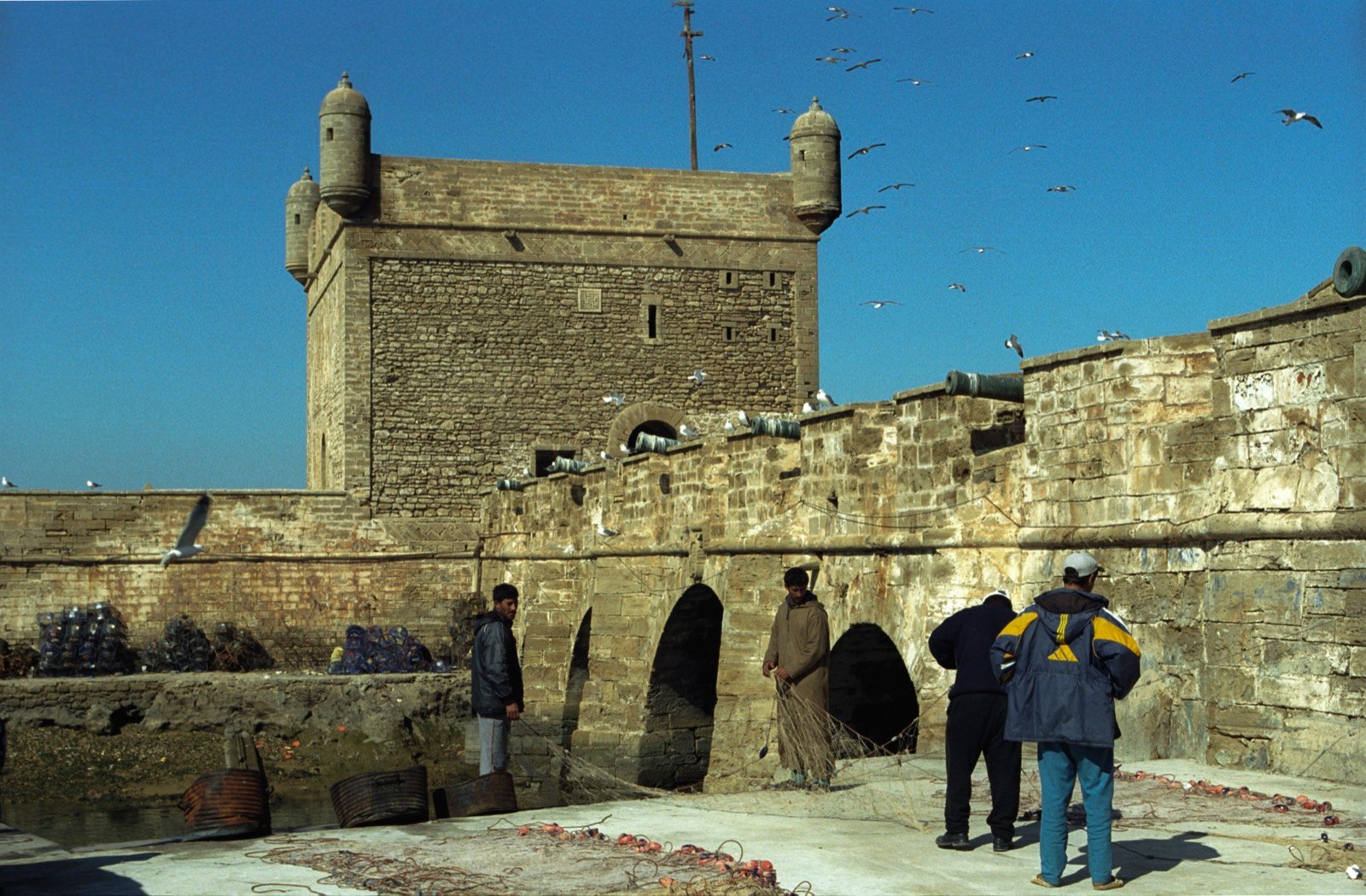
The Mellah, the old Jewish quarter in the northern corner of the medina near Bab Doukkala — beautiful, half-restored, and genuinely dark and empty at night. The market area outside Bab Marrakech, the bus and grand-taxi ground outside Bab Doukkala, the Chbanate district east of the walls, and the fishing port once the boats are in. Nothing sinister about any of them; they simply empty out, and an empty lane you do not know is not the place to test your sense of direction.
The long beach walk south past the football pitches towards the Oued Ksob river mouth, the Borj El Baroud ruins and the village of Diabat — this is the one stretch locals will actively warn you about, especially alone, with a camera out, or anywhere near dusk. Also the industrial zone on the Agadir road at night, and the unlit dune tracks behind the beach. Go to Diabat by taxi in daylight instead; it is a nice half-day, just not a nice walk on your own.
A practical booking note: riad addresses in the medina are close to unfindable by street name, and taxis cannot drive to your door. Ask your riad to meet you at the nearest gate — most will, for nothing or for a small tip — and ask them to send the pin. That one message removes the exact situation the fake-guide economy exists to exploit: a tired new arrival with luggage, standing at a gate, visibly unsure which way to go.
If you would rather be out of town entirely, Ghazoua and Sidi Kaouki are calm and lovely, but you are then dependent on taxis for every trip in and out, and the last one back is earlier than you think. Confirm your return ride before you go, not after dinner.
The scams to know
Essaouira’s scams are commercial, not violent. Nobody is trying to hurt you; somebody is trying to attach themselves to your afternoon and get paid for it. All of them collapse the moment you are unbothered, unhurried and specific. The general national picture is in our guide to common tourist scams in Morocco — these are the ones you will actually meet here.
Someone attaches themselves as you enter a gate, walks you somewhere useful, then names a fee. Official guides carry a badge and are booked through your riad. Say, warmly and without stopping: “La, shukran — I have a guide.” Then keep walking. Do not accept “just to show you, no money” — that sentence has a second half.
The square is closed, the souk is shut, there is a Berber market only today, the road ahead is blocked. It is not, and there isn’t. The destination is always a shop where your escort earns a commission. Smile, say you are just walking, and carry on the way you were going.
The blue grill stalls by the fishing port are a genuine Essaouira pleasure — and the classic overcharge. Fish is sold by weight, and the bill appears after you have eaten. Before anything is cooked: ask the price per kilo, choose the fish yourself, ask what the total will be, and have them confirm it. Stalls that answer clearly are the ones to sit at.
Someone takes your hand on Place Moulay Hassan and starts drawing before you have agreed to anything, then asks for a lot. Keep your hands to yourself and say no early — once it is on your skin the negotiation is over. Worth knowing separately: black henna often contains PPD and can cause real chemical burns. Natural henna is brown-orange, never black.
On the beach a ride is agreed, then the bill turns out to be per person, or per half hour, or excludes the guide. Agree the total, for everyone, for the whole ride, out loud, before you get on. If it is vague, walk away — there are ten more operators along that sand.
A driver or guide offers a stop at a women’s argan co-operative on the Marrakech or Agadir road. Real co-operatives exist and are worth visiting; many roadside versions are shops paying commission. Same road, same trick: the goats standing in the argan trees are placed there, and photographing them costs money you did not plan to spend.
Getting around safely
Essaouira has no tram and no railway station — the nearest trains are in Marrakech, and the connection is by road. Inside the walls there is nothing to get around by: the medina is pedestrian, and end to end on foot is about fifteen minutes. Everything else is taxis.
Petits taxis are the small city cabs, licensed to work inside Essaouira only. They queue at Bab Doukkala, Bab Marrakech and along the seafront. They have meters and are supposed to use them; ask for the meter as you get in, and if the driver declines, agree the fare before you sit down rather than after you arrive. They are shared by law, so a driver may pick up another passenger going your way — that is normal, not a diversion. Late at night, expect a night rate.
Grands taxis are the older estate cars that run fixed routes between towns — the airport, Sidi Kaouki, Ghazoua, Marrakech. They leave when full, six passengers, and you can pay for the empty seats if you want the car to yourself. Either way, agree the price or the number of seats you are buying before departure, in words both of you have said out loud.
Coaches — CTM and Supratours — run the Marrakech route in roughly three hours and are comfortable, punctual and the sensible way to arrive. They drop you outside the walls, a short walk or a very short taxi from any medina riad. Book seats ahead in summer and around the Gnaoua festival in June, when the town fills completely.
Ride-hailing does not meaningfully operate in Essaouira. Do not land expecting to open an app. If you want a fixed price and a named driver — for the airport, for a day trip, for a late arrival — ask your riad to arrange it. They use people they know, the price is agreed in advance, and the car is waiting. That is the local version of a ride-hailing app, and it works better here than the real thing.
Renting a car is straightforward and driving in Essaouira itself is calm, but you cannot drive into the medina — park outside the walls in a supervised lot and pay the attendant. Never leave anything visible inside the car.
Essaouira at night
Nights here are one of the reasons people extend their stay. Place Moulay Hassan fills with families after sunset, the café terraces stay busy, the main medina streets keep their shutters up and their lights on, and there is often music somewhere. Walking back through the medina at eleven at night is an ordinary thing that ordinary people do, including alone.
What changes after dark is the edges, not the centre. The souks wind down from around eight; the smaller residential lanes off the main arteries — particularly up in the Mellah — go quiet and unlit early. The ramparts close. The port empties. And the beach, which is the best place in town at five in the afternoon, becomes the worst place in town at ten at night: long, dark, unobserved, with no reason for anyone to be on it.
So the rule is simple and it is the same rule you would use in any small port town. Stay on the lit, populated streets — Avenue de l’Istiqlal, Rue Mohamed El Qorry, Place Moulay Hassan, the seafront road. If you have been out past the crowds, take a petit taxi to your gate rather than cutting through a shortcut you only walked once in daylight. If you have been drinking, take the taxi regardless. And if you are heading back from a restaurant outside the walls, ask them to call you a cab before you leave — it takes two minutes and removes the whole question.
One local practicality: many riads lock the outer door late. Tell them if you will be back after midnight, and take the number of someone who will answer. Standing outside a locked riad at 1am is not dangerous here, but it is a miserable half hour, and it is entirely avoidable.
Solo travellers, and solo women
Essaouira has a reputation among travellers as the gentlest Moroccan city to be alone in, and the reputation is earned. It is small enough that you become a familiar face within days. It has a long-staying surf, wind and music crowd, so a woman eating alone at a café is unremarkable. And the shopkeepers work the same street every day and would rather have a customer for the week than a sale for the afternoon.
What you will still experience, because you are in a Moroccan town and not a resort: comments. “Bonjour, gazelle.” “Where are you from?” “Just look, no buy.” Invitations into shops. Persistence from someone who wants to sell you a boat trip. Occasionally a follow of thirty metres down a street before the person gives up. It is verbal and it is tiring by day four. It is very rarely anything more, and physical harassment of visitors is uncommon here.
What actually works, from women who live and travel here:
- Do not engage. Answering “where are you from” starts a conversation that has a shop at the end of it. A brief “la, shukran” without breaking stride ends it. Silence works too and is not rude.
- Walk like you know where you are going — and if you do not, step into a café or a shop to check your phone rather than standing still in the middle of a lane looking at a map.
- Choose who you ask. Ask a woman, a shopkeeper standing in their own doorway, or someone working a stall. Anyone who approaches you first with directions is offering a service, not a favour.
- Dress for ease, not for rules. Swimwear on the beach is normal; cover your shoulders walking back into town and you will attract noticeably less attention. Nobody is going to challenge you either way.
- Arrive in daylight on your first day, with a pickup arranged. Almost every bad first evening in Morocco starts with arriving somewhere new after dark without a plan.
- Tell someone your shape of day. Not a full itinerary — just “I’m walking to Sidi Kaouki, back by six.” It costs one message.
Our fuller guide, Is Morocco safe for women?, goes deeper on the country as a whole. If keeping people at home in the loop is part of how you travel comfortably, this is how to set up a simple check-in plan that does not turn into hourly reporting.
Things not to do
- Do not walk the beach south towards the river mouth, the ruins or Diabat alone — and never at dusk. Take a taxi and go in the middle of the day.
- Do not leave a phone, a bag or a wallet on the sand while you swim. This is the single most common loss in Essaouira.
- Do not get into a taxi without either the meter running or the fare agreed out loud.
- Do not accept an unrequested guide, a “shortcut”, or help carrying your bag from someone who approached you.
- Do not buy hashish. It is illegal, it is offered constantly on the beach and in the medina, and the offer is frequently the first half of a shakedown.
- Do not photograph people — fishermen, women, Gnaoua musicians, anyone at work — without asking first. Ask, and you will usually get a yes and a conversation.
- Do not use a standalone ATM in a quiet street at night. Use a machine attached to a bank, in daylight, and put the cash away before you turn around. More on cash, cards and ATMs in Morocco.
- Do not drink the tap water if your stomach is at all sensitive — bottled is cheap and everywhere. Full food and water guide here.
- Do not swim off the main bay when the wind is up and the flags are down. The Atlantic here is cold, and the same wind that makes this a kitesurfing capital makes the currents serious.
Emergency numbers, and what to do
Save these three before you fly. They work from any Moroccan phone, and they are the numbers that matter.
Inside Essaouira you want 19. On the road out to Sidi Kaouki, Ghazoua, Diabat or the Marrakech highway you want 177 — that is the Gendarmerie Royale, who cover everything outside city limits. For a medical emergency, 15. Operators generally have some French; Arabic and French are the working languages, and English is hit and miss, so know the name of your street or your riad and be ready to say it slowly. Our page on emergency numbers in Morocco has the full list, including the tourist police.
Essaouira’s public hospital is the Hôpital Provincial Sidi Mohammed Ben Abdallah, a few minutes by petit taxi from the medina gates — the right destination for a broken wrist, stitches, a bad stomach or a scooter scrape. There are private clinics and plenty of pharmacies in town too; Moroccan pharmacies post the on-duty rota in the window, so if the shutter is down, the sign tells you who is open. For anything serious, the referral route is Marrakech, two and a half to three hours by road, where the large private hospitals are — we list them in the best hospitals in Marrakech for tourists.
The reason we built the free Stay Safe Morocco app is that all of the above is easy to read now and hard to do at the moment you need it. One tap dials the correct local number for where you are standing, logs your GPS, and sends your location to the Safety Circle you chose before the trip. That is what it does — there is no control room behind it and nobody is dispatched; it is your phone doing three things quickly that are difficult to do calmly under pressure. It also carries a directory of 172 hospitals across 31 cities, Check-on-Me timers for the days you are out on your own, safety zones that keep working with the app closed, and the essentials offline for when the signal drops on the coast road. The app is free, iOS, in English and French. The eSIM is the only thing we charge for.
The bottom line
Essaouira is safe, and it is a genuinely gentle place to be a first-timer in Morocco — small, walled, walkable, and far more relaxed than its reputation as a Moroccan city suggests. Stay inside the medina walls or on the Borj side of the beach, keep your bag closed in the crowds, agree prices before things happen rather than after, and stay off the long dark beach at night. Do that and the worst thing that will happen to you here is that you buy a rug you did not plan on.
Next step, and it takes ten minutes: put 19, 15 and 177 into your phone, sort your data before you fly so the map and the phone work from the moment you land, and tell one person at home roughly where you will be. Then go and enjoy the wind, the boats and the best fish on the Atlantic coast — with the confidence that you have already done the sensible part.
Frequently asked questions
Is Essaouira safe for tourists in 2026? Yes. Essaouira is one of the calmer, more relaxed Moroccan cities for visitors — small, walled and used to travellers. Violent crime against tourists is rare; the realistic risks are pickpocketing in busy market crowds, commercial overcharging, and isolated stretches of beach and dune south of town. Ordinary city awareness is enough.
Is Essaouira safe to walk at night? The main medina streets, Place Moulay Hassan and the lit seafront are comfortable to walk into the late evening, and people do so routinely. What you should avoid after dark is the beach, the port once the boats are in, the unlit residential lanes in the Mellah, and the dune tracks south of town. If you are outside the walls late, take a petit taxi to your gate.
Which area of Essaouira should I stay in? Stay inside the medina walls — around Place Moulay Hassan, the Kasbah, or on the main arteries like Avenue de l’Istiqlal and Rue Mohamed El Qorry. The seafront on Avenue Mohammed V and the Quartier Borj behind the beach are also comfortable and well lit. Ask your riad to meet you at the nearest gate, since taxis cannot drive into the medina.
Is Essaouira safe for solo female travellers? It is widely considered the easiest Moroccan city for women travelling alone: compact, familiar within days, and full of long-staying travellers, so eating or walking alone is unremarkable. You will still get verbal attention — comments, greetings, shop invitations — which is tiring rather than threatening. Not engaging, walking with purpose, and arriving in daylight handle almost all of it.
Are taxis in Essaouira safe, and how much should I pay? Taxis are safe and widely used. Petits taxis work inside the city and have meters — ask for the meter as you get in, and if the driver will not use it, agree the fare before you sit down rather than on arrival. Grands taxis run fixed routes to the airport, Sidi Kaouki and Marrakech, leaving when full; agree the number of seats you are paying for in advance. There is no working ride-hailing service in Essaouira, so for airport runs or late arrivals ask your riad to arrange a driver.
Is it safe to walk along the beach to Diabat? This is the one walk locals actively warn against. The stretch south past the football pitches towards the Oued Ksob river mouth, the Borj El Baroud ruins and Diabat is long, empty and unobserved, and it is where the few robberies of tourists tend to happen — especially alone or near dusk. Go by taxi, in the middle of the day, and it is a pleasant half-day trip.
What number do I call in an emergency in Essaouira? Dial 19 for police inside the city, 15 for an ambulance, and 177 for the Gendarmerie Royale if you are out on the roads towards Sidi Kaouki, Ghazoua or Marrakech. Save all three before you arrive. Essaouira’s public hospital is the Hôpital Provincial Sidi Mohammed Ben Abdallah, minutes from the medina by taxi; serious cases are referred to Marrakech.
We are the team behind Stay Safe Morocco, the free iOS safety app for visitors to Morocco. We built the one-tap SOS that dials Morocco’s real emergency numbers, the directory of 172 hospitals across 31 cities, and the Safety Circle that receives your location the moment you press SOS. We live and work here, and we keep this guide current.
🛡 Land in Morocco already connected — and safe
Every StaySafe Morocco eSIM comes with free Family SOS: one tap to reach emergency help and share your live location with your family. No data cap, keep your number, from $20.79.
Get your eSIM + Family SOS →Explore Morocco — city guides
- Agadir
- Best Places to Visit in Morocco: A First-Timer’s Shortlist
- Best Things to Do in Marrakech: The Essential Guide
- Casablanca
- Chefchaouen
- El Jadida
- Essaouira Culture Guide: Gnaoua Music, Art & Local Life
- Essaouira
- Fes
- Marrakech in Summer: Pools, Heat & How to Stay Cool
- Marrakech
- Meknes
- Nador
- Ouarzazate
- Oujda
- Places to Visit in Marrakech: A First-Timer’s Day-by-Day Map
- Rabat
- Safi
- Tangier
- Tétouan