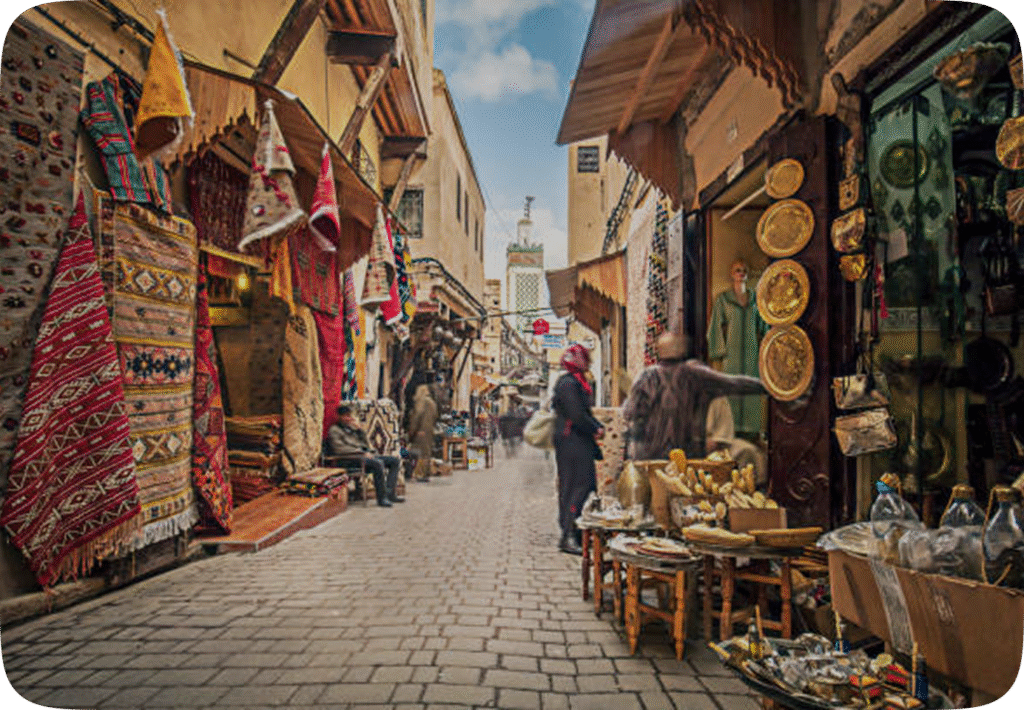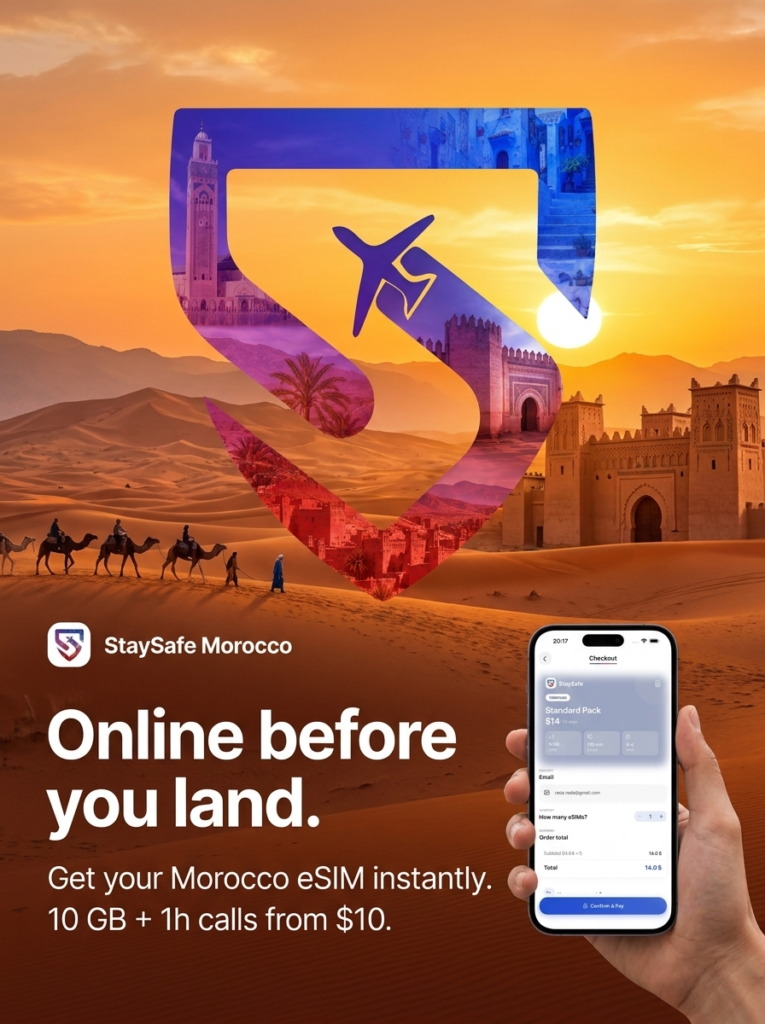
Landing in Marrakech with no data is a slow, stressful way to start a trip — hunting for a SIM kiosk, queuing at the airport, handing over your passport, and fiddling with a tiny plastic chip while taxis circle outside. There’s a better way. The best eSIM for Morocco lets you buy connectivity before you fly, so you step off the plane already online — maps, taxis, translation, and a working phone line from minute one. This guide walks through what actually makes a good Morocco eSIM, how much data a typical trip needs, how activation works, and which one we recommend (and why).
What makes a good Morocco eSIM?
Not all eSIMs are equal. When you compare options, these are the things that genuinely matter:
- Coverage on local networks. The eSIM should run on Morocco’s own mobile networks, not a patchy reseller signal. Local-network coverage means strong data in cities and reliable bars in the High Atlas, Sahara gateways, and coastal towns.
- Enough data for your trip. Too little and you’re rationing maps; too much and you’ve overpaid. (More on the right amount below.)
- Sensible validity. The plan should comfortably cover your stay — a long weekend or a two-week tour.
- Calls and SMS included. Useful for confirming a riad booking, calling a guide, or reaching a local number. Many generic eSIMs are data-only.
- Painless setup. You want a QR code emailed to you before departure, scanned in two minutes — no shop, no passport registration, no SIM swap.
- Fair, upfront price. A one-time charge you can see before you pay, not a surprise roaming bill.
- Real support. Someone to help if a code won’t scan the night before you fly.
Score any esim for Morocco against that list and the weak options fall away fast.

How much data do you actually need in Morocco?
This used to be the hardest question in the guide, and the one most travellers got wrong in both directions. It is no longer a question worth asking: the StaySafe Morocco eSIM has no data cap on any day of your plan. What you choose is not gigabytes but days, from 5 to 31.
$2.50 a day — $12.50 for a three-day trip. No data cap on any of them.
The week rate takes 25% off: $13.13 for seven days, about $1.88 a day.
The rate drops again to $1.30 a day — a full 31-day plan is $40.30.
If you have shopped for travel data before, the instinct is to estimate: maps sip data, video streaming and video calls drain it, so how many gigabytes will two weeks of Google Maps cost you? With no data cap, that arithmetic disappears. Stream on the train from Casablanca, video-call home from the Sahara, upload every photo the same evening — the price is the same either way, and it is still roughly the cost of a couple of coffees per day.

How eSIM activation works (it’s easier than a SIM card)
An eSIM is a digital SIM built into nearly every recent iPhone and Android phone — there’s nothing physical to insert. If you’ve ever wondered what an eSIM is and how to get the Morocco eSIM, the flow is simple:
1. Buy before you fly. Order online from home, on your normal Wi-Fi. 2. Get the QR code by email. Your eSIM’s QR code is emailed straight to you. 3. Scan it. Open your phone’s settings, scan the code, and the eSIM installs in about two minutes. 4. Land connected. Switch it on when you arrive and you’re online instantly — no shop, no swap, no airport queue.
Because there’s no plastic SIM to remove, your home number stays put on its own line — you just add Morocco data alongside it. (For the full comparison, see Morocco eSIM vs physical SIM.)
Why an eSIM beats roaming and airport SIMs
Three ways to get online in Morocco, three very different experiences:
- Roaming on your home plan is the most expensive option by far, with daily fees that stack up fast and the constant worry of a shock bill.
- An airport or shop SIM means queuing after a long flight, handing over your passport for registration, swapping out your home SIM (and not losing it), and hoping the staff speak your language.
- An eSIM is bought in advance, emailed to you, and live the moment you land — no queue, no passport desk, no swap.
For most visitors the eSIM wins on price, speed, and peace of mind. (We break down every option in how to get internet and data in Morocco.)
Our pick: the StaySafe Morocco eSIM
We build the StaySafe Morocco eSIM for exactly the traveller this guide is written for — someone who wants to land connected and explore confidently. It runs on local Moroccan mobile networks, comes as a QR code emailed to you before you fly, and includes calls and SMS, not just data. You buy with Apple Pay or Google Pay, it is a one-time purchase (never a subscription), and prices start from $12.50.
There are no tiers to compare. There is one plan, and you set its length:
No allowance, no top-ups, no throttling clause buried in the terms. Every day of your plan has no cap.
International and national calls, plus SMS — and your own number stays live on your normal SIM.
Match the plan to your actual trip. The longer the trip, the lower the per-day rate.
For the live price on your exact dates, use the picker on the Morocco eSIM page — it costs from $12.50, or $1.30 a day on longer trips.
The part generic eSIMs can’t match
Most eSIM brands sell you data and stop there. StaySafe Morocco pairs your eSIM with a free safety app built specifically for visitors to Morocco:
- One-tap access to the correct Moroccan emergency numbers — police, ambulance, gendarmerie and more — so you’re never searching in a stressful moment.
- Danger-zone alerts that warn you about flagged areas even when the app is closed.
- A Morocco hospital, pharmacy, and medication directory for when you need to find care or check a medicine quickly.
That’s the difference: a generic eSIM keeps you online; the StaySafe eSIM keeps you online and gives you a safety net for the rare moment something goes wrong. Stay connected. Stay safe. (New to the country? Start with is Morocco safe for tourists? for the honest picture.)
The bottom line
The best eSIM for Morocco is the one that runs on local networks, carries the right amount of data for your trip, includes calls and SMS, installs in two minutes from an emailed QR code, and costs a fair, upfront price. The StaySafe Morocco eSIM does all of that from $12.50 — and adds a free safety app no generic eSIM offers. Buy it before you fly, land already connected, and spend your first hour in Morocco exploring instead of queuing.
Frequently asked questions
What is the best eSIM for Morocco? The best eSIM for Morocco runs on local Moroccan networks, gives you enough data for your trip, includes calls and SMS, and installs in minutes from an emailed QR code. The StaySafe Morocco eSIM does all of this from $12.50 and pairs with a free safety app built for visitors to Morocco.
How much data do I need for a trip to Morocco? You no longer need to work it out. The StaySafe Morocco eSIM has no data cap on any day of the plan, so instead of estimating gigabytes you simply choose how many days you are in the country — anywhere from 5 to 31. Streaming and video calls, which are what actually drain a capped plan, cost you nothing extra.
How do I set up an eSIM for Morocco? Buy the eSIM online before you fly, receive the QR code by email, and scan it in your phone’s settings — it installs in about two minutes. Switch it on when you land and you’re connected instantly, with no shop visit, passport registration, or SIM swapping.
Is an eSIM better than a SIM card for Morocco? For most visitors, yes. An eSIM is bought in advance and live the moment you land, so there’s no airport queue, no passport desk, and no swapping out your home SIM. See our Morocco eSIM vs physical SIM guide for the full comparison.
Does the StaySafe Morocco eSIM include calls? Yes. Every plan includes 2 hours of calls (international and national) plus SMS — not just data. You can buy with Apple Pay or Google Pay as a one-time purchase. Check the Morocco eSIM page for current prices, from $12.50.
Ready to get connected in Morocco?
No data cap from $2.79 a day — choose 7 to 31 days, get your QR code by email, and the free StaySafe safety app comes with every eSIM.
View Morocco eSIM plans →Explore Morocco — city guides
- Agadir
- Best Places to Visit in Morocco: A First-Timer’s Shortlist
- Best Things to Do in Marrakech: The Essential Guide
- Casablanca
- Chefchaouen
- El Jadida
- Essaouira Culture Guide: Gnaoua Music, Art & Local Life
- Essaouira
- Fes
- Marrakech in Summer: Pools, Heat & How to Stay Cool
- Marrakech
- Meknes
- Nador
- Ouarzazate
- Oujda
- Places to Visit in Marrakech: A First-Timer’s Day-by-Day Map
- Rabat
- Safi
- Tangier
- Tétouan