Planning a trip to Morocco and wondering how to get online once you land? You’ve basically got two choices: a Morocco eSIM you set up before you fly, or a physical SIM card you buy after you arrive. Both get you data, both work on the local network — but they feel very different the moment you step off the plane. This honest, head-to-head guide walks through eSIM vs SIM card for Morocco across setup, cost, coverage, and hassle, so you can pick the right one with confidence.

The short answer
For most short-trip tourists with a modern phone, an eSIM wins — you buy it at home, scan a QR code, and land already connected, with no queue and no SIM swap. A physical SIM still makes sense in a few specific cases (a very long stay, an older phone, or a real need for a local Moroccan number). The rest of this guide explains exactly why, so you can decide for yourself.
eSIM vs physical SIM card in Morocco: side-by-side
Here’s how the two options compare across everything that actually matters for a Morocco trip.
eSIM: Buy online, scan a QR code, done — no SIM swap. Physical SIM: Buy in person at the airport or a shop; staff insert and activate it for you.
eSIM: Active the moment you land — set it up before you fly. Physical SIM: Only after you arrive, queue, and get it activated.
eSIM: Fixed, paid upfront in your own currency — StaySafe Morocco eSIM from $9. Physical SIM: Pay locally in dirham; price varies by shop and how much data you add.
Both run on local Moroccan carrier networks — strong in cities and on main tourist routes. Coverage isn’t the deciding factor here.
eSIM: Yes — your physical SIM stays in, so calls and texts to your home number still arrive. Physical SIM: Usually no — you remove your home SIM to fit the local one.
eSIM: Almost none — no queue, no passport at a counter, no swapping tiny cards. Physical SIM: Queueing, sometimes showing your passport, swapping (and not losing) your home SIM.
eSIM: Short trips, modern phones, travellers who want to land ready. Physical SIM: Very long stays, older phones, or anyone who needs a local Moroccan number.
The eSIM option, honestly
An eSIM (“embedded SIM”) is a digital SIM already built into most phones from the last few years. Instead of slotting in a plastic card, you install a data plan by scanning a QR code. If you’re new to the idea, our explainer on what is an eSIM? breaks it down in plain English.
Where the eSIM shines
- You land connected. Buy and install before you fly, and your data is live the minute the plane touches down — maps, taxis, translation, and a working line straight away. No hunting for a shop with your luggage.
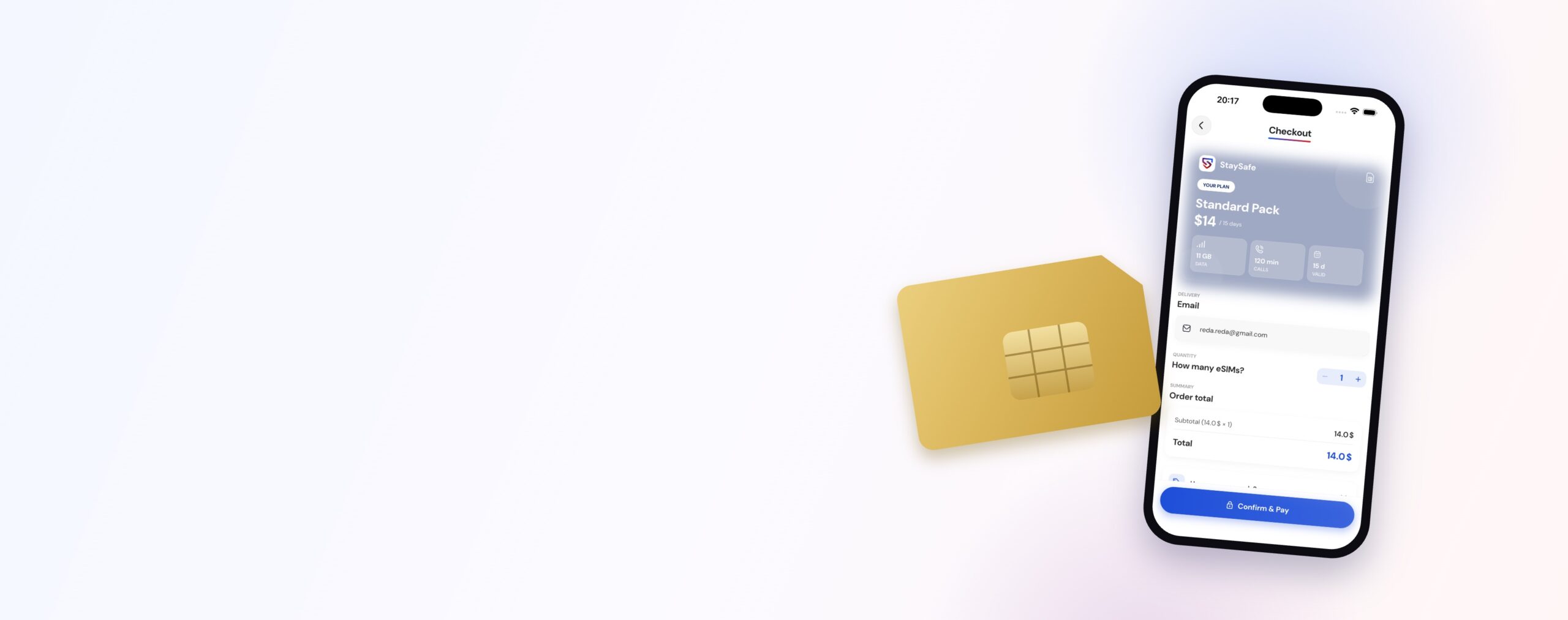
- No queue, no SIM swap. With StaySafe Morocco, the QR code is emailed to you instantly. You set it up at home, and your physical home SIM stays exactly where it is.
- You keep your home number. Because the eSIM is separate from your physical SIM, calls and texts to your usual number still come through. Handy for two-factor codes and family staying in touch.
- Simple, upfront pricing. One-time purchase, paid in your own currency with Apple Pay or Google Pay — no surprise top-ups. Plans run 10, 15, and 20 GB, with calls included (1 hour on the 10 GB plan; 2 hours on the 15 and 20 GB plans, national and international).
- It’s paired with a free safety app. The StaySafe eSIM comes alongside our safety companion, so you’re not just connected — you’ve got Morocco’s emergency numbers and local tools one tap away.
Where the eSIM has limits
- Your phone has to support it. Most recent iPhones and flagship Android phones do, but some older or budget models don’t. Check before you buy (we cover this in the FAQ).
- It’s a data + calls plan, not a local number. If you specifically need a Moroccan phone number — say, for a local business or a long-term rental listing — a physical SIM is the better fit.
Want our full pick and setup walkthrough? See the best eSIM for Morocco guide.

The physical SIM option, honestly
A physical SIM card is the traditional route: you land, find a carrier shop or an airport kiosk, and buy a local tourist SIM. Morocco’s main carriers are Maroc Telecom, Orange Maroc, and inwi, and all three sell prepaid tourist SIMs.
Where the physical SIM shines
- It gives you a real local number. If you genuinely need a Moroccan number — for a longer stay, local services, or someone who’ll only call a local line — this is the cleaner option.
- It can suit very long trips. For stays of many weeks or months, topping up a local prepaid SIM in person can work well, and you’ll have plenty of shops around to do it.
- It works on any unlocked phone. No eSIM support required — even an older handset takes a standard SIM.
Where the physical SIM costs you
- You arrive disconnected. You can’t buy it until you’re on the ground, so your first hour or two — often the most disorienting part of any trip — is spent offline, queueing instead of exploring.
- There’s a queue and some admin. Buying a tourist SIM usually means lining up at a counter, sometimes showing your passport to register the SIM, and waiting for activation.
- You swap out your home SIM. That tiny card has to go somewhere safe (people lose them), and while it’s out, calls and texts to your home number won’t reach you.
- Pricing isn’t always transparent. Costs vary by shop and by how much data you add, and language barriers at the counter can make it tricky to know exactly what you’re paying for.
Coverage itself isn’t the deciding factor here — both an eSIM and a local SIM run on Moroccan carrier networks, and coverage is good across the cities most tourists visit.

So, do you need a SIM card in Morocco at all?
You don’t strictly need a physical SIM — but you do want mobile data. Trying to navigate medinas, agree taxi fares, translate menus, or call for help without it makes Morocco harder and less safe than it needs to be. The real question isn’t whether to get connected, but how. For more on every route (including roaming and Wi-Fi), see how to get internet & data in Morocco.
The verdict
For most tourists on a short trip with a modern phone, the Morocco eSIM is the smarter buy: you set it up before you fly, land already online, skip the queue and the passport counter, keep your home number, and pay a clear price upfront. It’s the “explore confidently from minute one” option.
A physical SIM still earns its place if you’re staying a very long time, your phone doesn’t support eSIM, or you specifically need a local Moroccan number. Those are real cases — just not the typical short-trip tourist’s.
If you’re in the eSIM camp, the StaySafe Morocco eSIM gives you 10, 15, or 20 GB from $9, delivered as a QR code by email instantly, set up before you fly with no SIM swap, on a local Moroccan network, and paired with a free safety app. Get your Morocco eSIM here and land ready to go.
Frequently asked questions
Is an eSIM or a SIM card better for Morocco? For most short-trip tourists with a modern phone, an eSIM is better: you set it up before you fly, land already connected, skip the queue and SIM swap, and keep your home number. A physical SIM is better mainly for very long stays, older phones that don’t support eSIM, or if you specifically need a local Moroccan number.
Do I need a SIM card in Morocco? You don’t need a physical SIM, but you do want mobile data for maps, taxis, translation, and calling for help. An eSIM is the simplest way to get it — you set it up before you arrive and land already online, with no shop visit or SIM swap.
Will an eSIM work on my phone in Morocco? Most recent iPhones and flagship Android phones support eSIM, but some older or budget models don’t. Check your phone’s settings or specs for “eSIM” or “add a data plan” before you buy. If your phone doesn’t support it, a physical SIM is the way to go.
Can I keep my home number while using a Morocco eSIM? Yes. An eSIM is separate from your physical SIM, so your home SIM stays in your phone and calls and texts to your usual number still come through — useful for two-factor codes and staying reachable. With a physical local SIM, you usually remove your home SIM to fit it.
How much does a Morocco eSIM cost? The StaySafe Morocco eSIM starts from $9, with plans of 10, 15, and 20 GB. It’s a one-time purchase paid with Apple Pay or Google Pay, and the QR code is emailed to you instantly so you can set it up before you fly. Local physical SIM prices vary by carrier and shop.
Ready to get connected in Morocco?
No data cap from $2.79 a day — choose 7 to 31 days, get your QR code by email, and the free StaySafe safety app comes with every eSIM.
View Morocco eSIM plans →Explore Morocco — city guides
- Agadir
- Best Places to Visit in Morocco: A First-Timer’s Shortlist
- Best Things to Do in Marrakech: The Essential Guide
- Casablanca
- Chefchaouen
- El Jadida
- Essaouira Culture Guide: Gnaoua Music, Art & Local Life
- Essaouira
- Fes
- Marrakech in Summer: Pools, Heat & How to Stay Cool
- Marrakech
- Meknes
- Nador
- Ouarzazate
- Oujda
- Places to Visit in Marrakech: A First-Timer’s Day-by-Day Map
- Rabat
- Safi
- Tangier
- Tétouan