Somebody at home is going to ask you to text when you land. Then again when you reach the riad. Then again, quietly, every evening you are away. That is not doubt about Morocco — it is love, and it is easily satisfied. The trick is to decide how you will stay in touch before you fly, so it takes ten seconds a day instead of a running negotiation across time zones.
Staying in touch in Morocco comes down to three things: a data line that is already working when the plane doors open, a check-in rhythm you both agreed on in advance, and a short list of numbers that still work when the bars disappear. Set all three up in about ten minutes and the conversation back home changes from “are you okay?” to “what did you eat today?”
Land already connected, not hunting for Wi-Fi
The weakest link in most people’s plan is the first hour. You land at Marrakech Menara or Casablanca Mohammed V, your home SIM is either off or roaming at a price you would rather not think about, and airport Wi-Fi wants an SMS code sent to a number that cannot receive it. That is when the “just landed” message does not get sent, and that is when someone at home starts calling the airline.
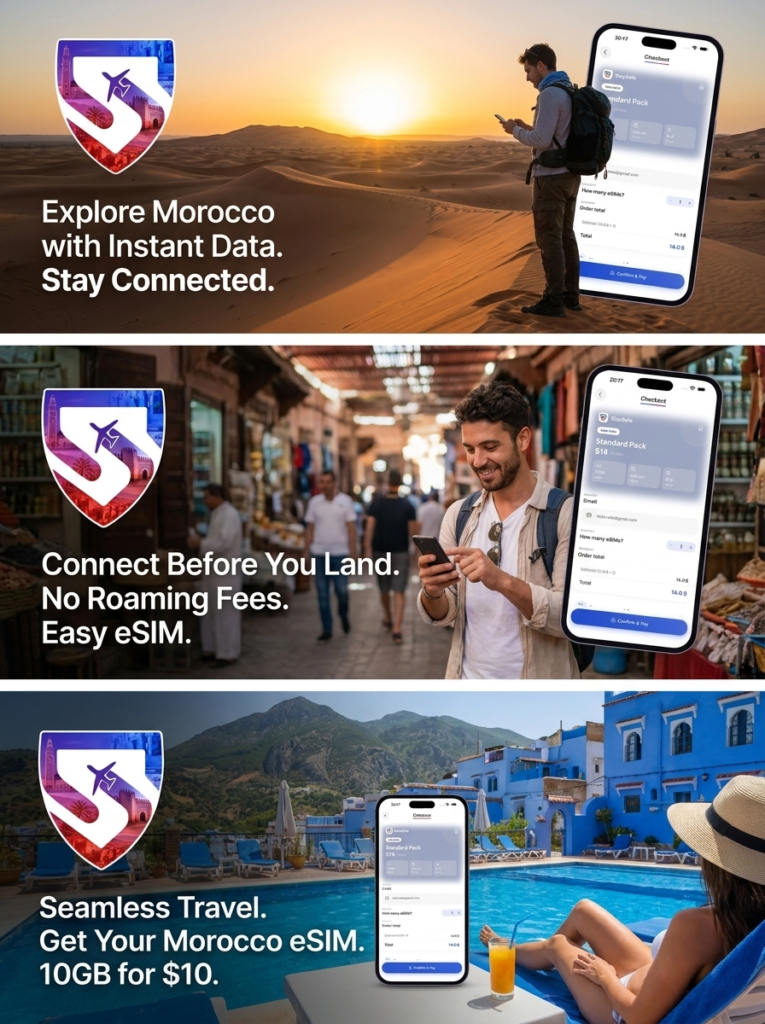
An eSIM removes that hour entirely. You install it at home, on your own Wi-Fi, days before you travel; it sits dormant on your phone and connects to a Moroccan network as soon as you switch off flight mode on the runway. Our packs come in 10 GB, 15 GB and 20 GB, from $9, and they include local calling minutes too — roughly an hour on the 10 GB pack and around two hours on the larger ones. That matters more than it sounds for keeping in touch: if a data call drops or your parents have never quite mastered WhatsApp, you can simply ring their phone from a Moroccan line. If you are unsure which size to buy, our guide to how much data you actually need works it out by trip length.
Agree the plan before you fly
The most common cause of panic at home is not something going wrong in Morocco. It is a message arriving three hours later than expected, with no agreed meaning attached to silence. Five minutes of conversation before you leave prevents nearly all of it.
Say “you will hear from me every evening between 7 and 10pm Morocco time.” One window, not a stream of messages. Morocco is on GMT+1, so for the UK that is roughly the same clock, and for the US East Coast it is five hours ahead.
Agree that a missed window means “busy, in the mountains, or out of signal” — not “something happened.” Then agree what would genuinely warrant a phone call: two missed windows in a row, say.
Send the list of cities, dates, and the riad or hotel names before you go. A single message with your accommodation details answers ninety per cent of the questions they would otherwise ask nightly.
Choose the one person who hears from you and passes it on. Reporting to four relatives separately is how a check-in habit collapses by day three.
Give them your Moroccan number, your accommodation’s number, and your embassy’s contact details in Rabat. Someone at home who has the numbers feels useful rather than helpless.
Share a moment, not your whole trip
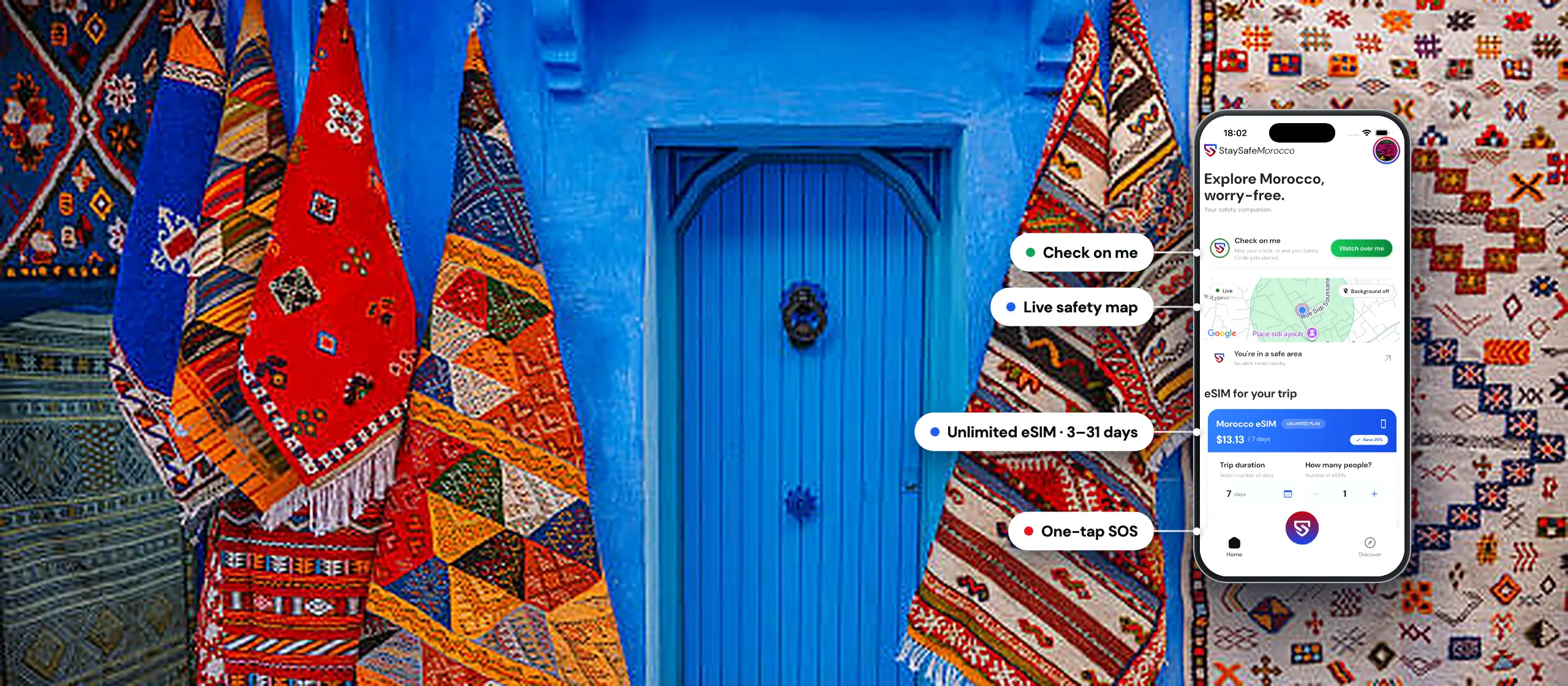
There is a middle ground between broadcasting your location twenty-four hours a day and going dark. In the Stay Safe Morocco app you build a Safety Circle — the two or three people who would actually act if they needed to — and then share Live Location with them only when it is worth sharing. A late taxi from Fes to your guesthouse. A guided trek out of Imlil. The one evening you go to a restaurant across town on your own.
Deliberate sharing is more useful than constant sharing, because it carries information. A location that appears at 11pm on a Tuesday tells your circle “she wanted us to see this one.” A location that has been on for nine days tells them nothing at all, and drains your battery while saying it. You turn it on, you turn it off, and nobody is watching a dot in between. The app is in English and French, so a French-speaking friend or host can read it with you.

Let the arrival check-in do the messaging for you
Some days you will simply forget. You arrive in Chefchaouen at dusk, the blue walls do their thing, you get talking to your host, and the evening disappears. That is exactly the day your check-in matters most to whoever is waiting.
So the app’s Trip Planner handles that one for you. Add a leg — Marrakech to Essaouira, Tangier to Rabat, the overnight to Merzouga — and when you confirm you have arrived, your Safety Circle is notified automatically. It is the one thing in the app that reaches out on your behalf, and it is deliberately limited to arrivals, because a notification that means something specific is worth ten that do not. Pair it with Check-on-Me when you head out for a few hours and want a nudge to confirm you are back.
The numbers that work even when nothing else does
Everything above assumes a normal, pleasant trip, which is almost certainly the one you will have. But a check-in plan is only reassuring if it also covers the rare bad evening — and in Morocco that is a short, memorable list. These numbers are free, and 112 connects even with no SIM card and no credit on the phone.
The city-versus-countryside split is the part travellers rarely know: 19 is the police force that covers urban areas, while 177 is the gendarmerie, who patrol rural roads and the routes between towns. If you are on the road to the Dades Valley, 177 is your number. When in doubt, 112 routes you either way. Our full breakdown of Morocco’s emergency numbers for tourists covers what to say and in which language.
The one-tap SOS in the app is built around exactly this: it logs your location and puts those local numbers a single tap away, so you are not searching for a country’s emergency number while your hands are shaking. It does not call your family for you and it is not a monitored alarm service — it is a fast, calm route to Moroccan emergency services, which is what actually helps in the moment. Telling your Safety Circle honestly what it does, and what it does not, is part of a good plan.

Plan for the evenings with no signal — they are the good ones
Coverage across Morocco is genuinely good in the cities, along the main train line and on the coast. It thins out where you would expect: deep in the Atlas, out past Merzouga, in some stretches of the Draa Valley. Those are also the nights you travelled for, so plan around them rather than avoiding them.
Two things make it painless. First, tell your point of contact in advance which nights will be quiet — “Thursday I am in the desert, you will hear from me Friday lunchtime” — and the silence stops being ominous. Second, keep the essentials on the phone rather than in the cloud: the app’s Offline Ready content, including emergency numbers and My Embassy details for your nationality, opens with no connection at all. Screenshot your booking confirmations too. Our guide to what still works on your phone with no signal goes through the rest.
A rhythm that survives the whole trip
Habits that require effort die around day four. Here is the version that tends to last a fortnight:
- One message, one photo, once a day. A picture of what you ate does more reassuring work than a paragraph, and takes five seconds to send.
- Confirm arrivals, not departures. “In Essaouira” closes the loop. “Getting on the bus” opens one that stays open for four hours.
- Charge before you go out, not when you get back. A power bank is the single most useful safety accessory you will carry — every feature here needs battery.
- Keep the home SIM reachable. Leave your normal number active for bank codes and two-factor messages, and use the Moroccan line for everything else.
- Let them see the trip, not just the check-ins. If the only contact is a status report, it starts to feel like surveillance for both of you.
If the person at home is anxious about Morocco in general rather than about your itinerary specifically, send them our national overview: is Morocco safe for tourists answers the questions they are too polite to ask you directly, with actual context instead of headlines.
The bottom line
Staying in touch in Morocco is not a technical problem, and it is certainly not a reason for anyone to worry. It is a small amount of planning that buys a large amount of calm on both ends of the line. Install your eSIM before you fly so you are connected the moment the wheels touch down. Agree one daily window and one point of contact. Put your two or three people in your Safety Circle, share Live Location when it genuinely helps, and let the Trip Planner arrival check-in cover the evenings you get happily distracted. Keep 112, 19, 177 and 15 on a phone that works offline.
Do that, and the people at home stop tracking you and start following along — which is what they wanted in the first place. You get the medina, the mountains and the long dinners without an unread-message count hanging over them.
Frequently asked questions
Will my phone work the moment I land in Morocco? If you install an eSIM before you fly, yes. It stays dormant until you switch off flight mode in Morocco, then connects to a local network — usually within a minute or two of landing, so your “arrived safely” message goes out from the aircraft steps rather than after you find Wi-Fi.
Can my family see where I am for my whole trip? Only if you choose to share. Live Location in the Stay Safe Morocco app is something you switch on for a specific journey or evening and switch off afterwards. The one automatic notification is the Trip Planner arrival check-in, which tells your Safety Circle you have reached a planned destination.
Does the SOS button call my family? No — and it is worth telling them so. SOS logs your location and puts Morocco’s emergency numbers one tap away so you can reach local services immediately. It is not a monitored alarm service and it does not contact your circle for you, which is exactly why an agreed check-in plan sits alongside it.
What happens if I lose signal in the desert or the High Atlas? The app’s Offline Ready content, including the emergency numbers and your embassy details, still opens with no connection. The universal emergency number 112 connects without a SIM card or credit wherever there is any network at all. Warn your point of contact in advance which nights will be quiet.
How much data do I need to video-call home every day? A daily video call of ten to fifteen minutes, plus maps and messaging, sits comfortably inside 10 GB for a one-week trip; two weeks or heavy uploading is better served by 15 GB or 20 GB. Packs start from $9 and include local calling minutes, so you can also ring a landline back home directly.
🛡 Land in Morocco already connected — and safe
Every StaySafe Morocco eSIM comes with free Family SOS: one tap to reach emergency help and share your live location with your family. No data cap, keep your number, from $20.79.
Get your eSIM + Family SOS →Before you go — related guides
- Is Morocco safe for tourists?
- Emergency numbers in Morocco
- Common scams in Morocco & how to avoid them
- How to get internet & mobile data in Morocco
- How to get a SIM / eSIM in Morocco
- Best eSIM for Morocco: plans & prices
- Buy a Morocco eSIM — no data cap, your dates
- Morocco eSIM setup: device check & activation
- What is an eSIM and how does it work?
Explore Morocco — city guides
- Agadir
- Best Places to Visit in Morocco: A First-Timer’s Shortlist
- Best Things to Do in Marrakech: The Essential Guide
- Casablanca
- Chefchaouen
- El Jadida
- Essaouira Culture Guide: Gnaoua Music, Art & Local Life
- Essaouira
- Fes
- Marrakech in Summer: Pools, Heat & How to Stay Cool
- Marrakech
- Meknes
- Nador
- Ouarzazate
- Oujda
- Places to Visit in Marrakech: A First-Timer’s Day-by-Day Map
- Rabat
- Safi
- Tangier
- Tétouan