Yes — Fes is safe for visitors, and it is one of the great walking cities on earth. Violent crime against tourists is rare, the medina is full of families and shopkeepers who have been on the same corner for thirty years, and the vast majority of first-timers leave having lost nothing worse than an afternoon to a wrong turn. What Fes asks of you is not courage. It asks for ordinary city sense, a working phone, and a willingness to say “no thank you” and keep walking.
This guide is the honest version: the neighbourhoods worth booking, the ones to leave by taxi after dark, the specific hustles you will meet in the first hour, how taxis actually work here, what nights are like, what solo travellers and solo women should expect, and the three numbers to save before you land. If you want museums, tanneries and the Qarawiyyin, our Fes travel guide covers things to see. This page answers a different question.
The short answer
Fes is safe for visitors, with the usual big-city sense: the real risks are commercial, not violent — a fake guide, an inflated fare, a hard sell you did not agree to — and every one of them is defused by a calm, unembarrassed “no”. Stay near Batha, the upper Talaa or the Ville Nouvelle, take a taxi home after dark, and you will be fine.
Fes is Morocco’s spiritual and scholarly capital, a city of about 1.2 million people, and Fes el-Bali is the largest car-free urban area in the world — roughly 9,000 lanes with no through traffic. That last fact explains almost everything about safety here. There are no cars to be hit by and nowhere for a getaway vehicle, but there is a genuine maze, and being lost in a maze at night is the thing that frightens people most. It is solvable, and this guide solves it.
Fes also receives far fewer visitors than Marrakech, which cuts both ways. The pressure is gentler and the city feels more like itself; but there is also less of a tourist-facing machine around you, fewer English speakers off the main arteries, and a stronger reason to have your riad’s phone number in your pocket. For the national picture, our guide to whether Morocco is safe for tourists sets the wider context.
Staying connected in Fes
In a medina with no street signs and no car access, a working phone stops being a convenience and becomes the practical safety tool. It is your map when the lane you wanted is a dead end, your translator, the way you call your riad to come and collect you, the way you show a taxi driver exactly where you are going, and the way you dial 19 if you ever need to. Airport Wi-Fi does not follow you into Derb Jouhala.
The simplest fix is a Morocco eSIM installed before you fly: it arrives as a QR code by email, and it connects the moment your plane lands, before you have found the baggage carousel. Ours gives you unlimited data for the number of days you are actually here, plus two hours of calls and 24/7 support — see the current details on the Morocco eSIM page. If you have never used one, here is what an eSIM is in plain language.
Pair it with our free iOS app, which gives you one-tap SOS that dials the correct Moroccan emergency number for where you are standing, logs your GPS and sends it to your Safety Circle. Also download an offline map of Fes before you go. Coverage in the medina is good, but stone walls three storeys high are stone walls.
Where to stay, and where to be careful
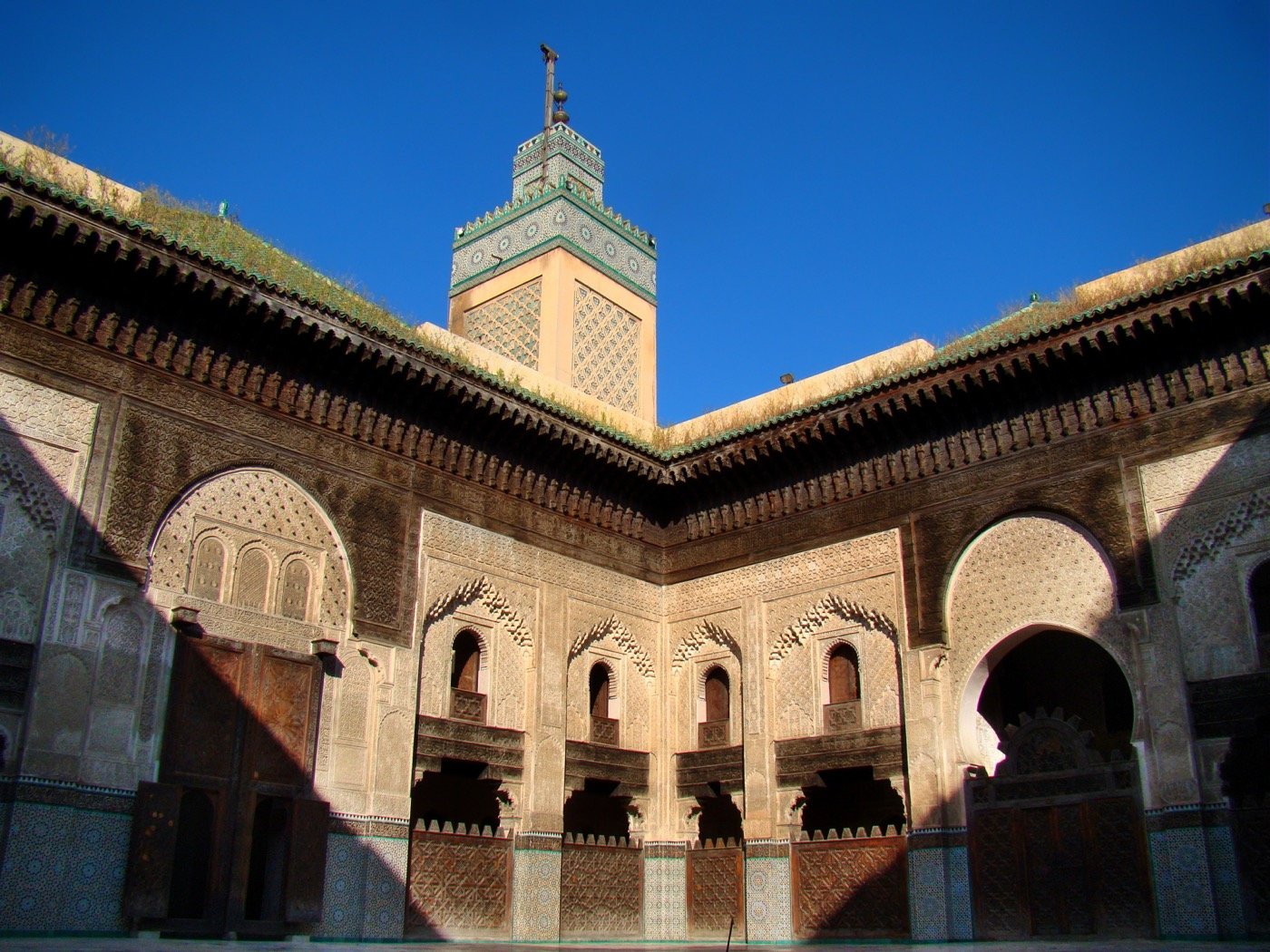
This is the decision that shapes your whole trip, so here are real names rather than vague advice. Fes has three worlds: Fes el-Bali, the ancient medina; Fes el-Jdid, the 13th-century royal city with the Mellah and the palace gates; and the Ville Nouvelle, the wide French-built grid where the trains, banks and late cafés are. Most visitors should stay in the medina — that is the reason you came — but the specific corner matters far more than the postcode.
Comfortable day and night
The medina’s front door. Riads, the Batha museum, the Jnan Sbil gardens, and — crucially — a road where taxis wait, so you can be dropped within a two-minute walk of your door at midnight. The single best choice for a first visit.
The two main arteries running down from Bab Bou Jeloud, the blue gate. Busy, lined with shops and food, lit well into the evening, and impossible to get properly lost on because they only go one way: down.
Quiet riad quarters a few short derbs inside the medina near Batha. Residential and calm, close enough that any riad will send someone to walk you in from the taxi if you call ahead.
Wide pavements, streetlights, banks, pharmacies, families out until late. Not atmospheric, but if you are arriving on a night train or travelling with an anxious companion, this is the easy option.
Fine by day, take a taxi after dark
The beating heart of the medina and its transport hub — taxis, buses, a huge produce market. Superb by day. After about ten it empties fast, so arrive by taxi rather than walking down through the lanes.
The famous vats, and the tightest lanes in the city. Visit in the morning when the light is best and the shops are open; there is nothing there at night but shutters.
The deepest, most beautiful part of Fes el-Bali and a genuine labyrinth. Wonderful to be lost in at 11am. At 11pm, take a taxi to R’cif or Batha and walk in from there.
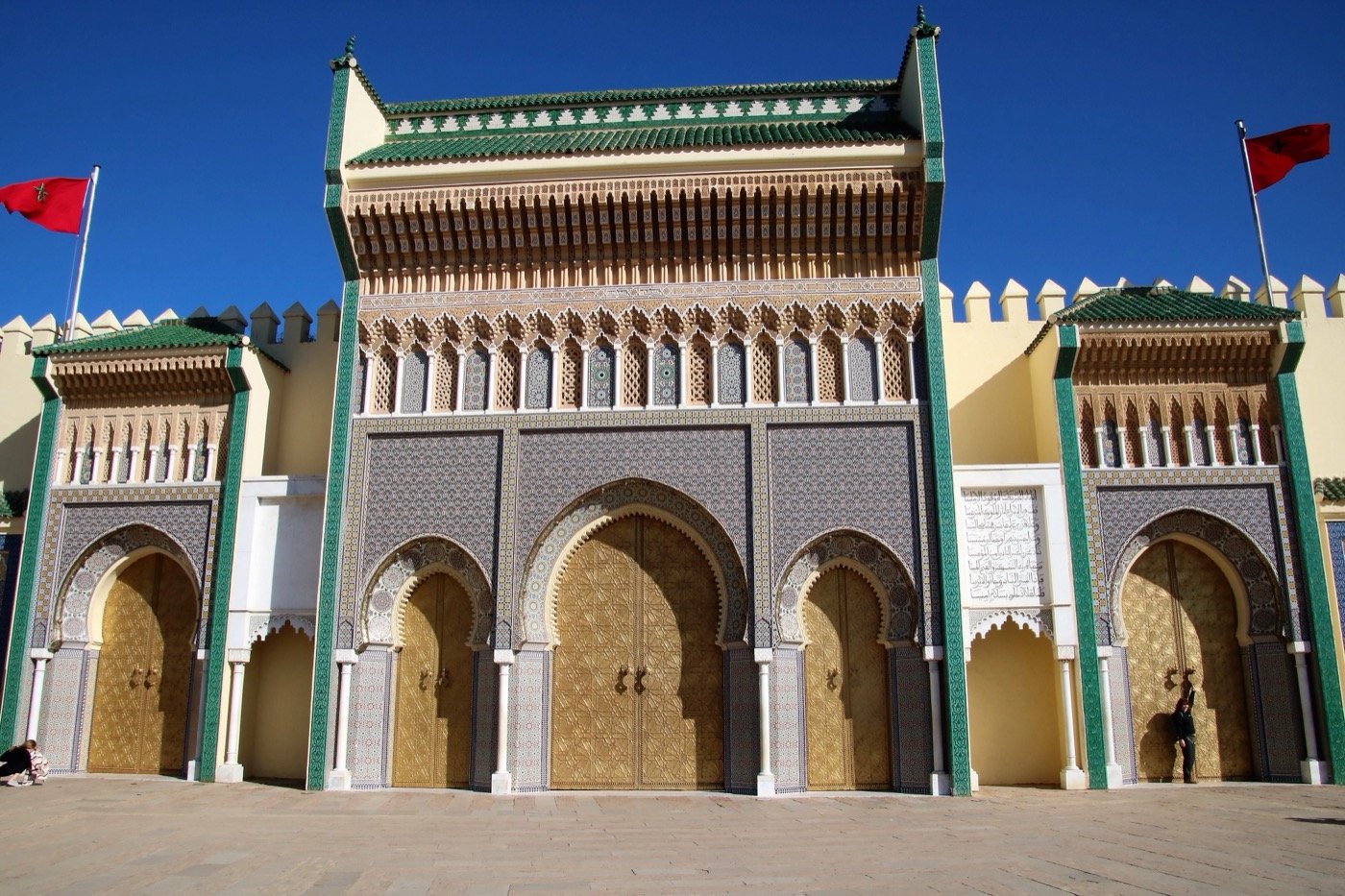
The old Jewish quarter, the Ibn Danan synagogue, the hillside cemetery and the golden palace doors at Place des Alaouites. An excellent half-day. Quiet and shuttered in the evening.
The classic sunset panorama over the whole medina, and worth it. Go up by taxi, go with someone, and come down before the light has fully gone — the slope is open ground with no one around after dark.
Better skipped unless you know the city
The far south-eastern edge. Unlit, open and empty once the shops close. Nothing sinister — simply nowhere a visitor has any reason to be after dark.
The unlit dead-ends of the Andalous quarter and Ain Azliten are ordinary family neighbourhoods. The problem is not the people; it is that you will be lost, in the dark, with no landmarks and no one about to ask.
The long walls look romantic on a map. In practice it is an unpeopled stretch with no lighting and no exits. Walk it in daylight or not at all.
Normal working suburbs with nothing for a visitor, poorly served by taxis late, and a long dark walk if you misjudge it. Book your room somewhere else.
The scams to know
Almost every unpleasant story from Fes belongs on this list, and every item on it is a commercial hustle rather than a threat. Learn the shape of them once and they stop working. Our wider guide to common tourist scams in Morocco covers the national versions; these are the ones Fes specialises in.
A friendly man attaches himself at Bab Bou Jeloud, talks for ten minutes, then names a price — or steers you into his cousin’s bazaar for commission. Say: “No thank you, I have a guide.” Then stop replying. Licensed guides carry a national ministry card; ask to see it, or book through your riad and the problem disappears entirely.
The tannery is closed, the medersa is closed, there’s a Berber market only today, that street is blocked for a festival. It is a redirect, not information. Say: “Thanks, I’ll go and look anyway.” Then carry on in the direction you were already walking.
Someone hands you a sprig of mint, walks you up to a rooftop over the Chouara vats, and afterwards a substantial “entrance fee” appears. The view really is from private shop terraces and a small tip is fair — so settle it at the bottom of the stairs. Say: “I’ll give you 20 dirhams for the view, and I’m not buying leather today.”
Near R’cif and Bab Bou Jeloud, a woman may take your hand and begin drawing before you have agreed to anything, then ask for a large sum. Keep your hands to yourself and say “la, shukran” firmly. There is also a health reason: black henna often contains PPD, which can burn skin. Real henna is orange-brown.
A teenager walks thirty seconds ahead of you, turns one corner, and asks for money. If you did not ask, do not follow. If you did ask and were genuinely helped, a small coin is normal and generous. Say up front: “I don’t need help, thank you.”
A petit taxi driver refuses the meter and quotes a flat fare three times the real one. Say: “Compteur, s’il vous plaît.” If he says no, close the door and take the next one — there is always a next one within a minute.
You pay with a 200 and get change for a 20, or receive a worn note nobody will accept later. Count notes in your hand before putting them away, and carry small denominations. Our guide to money in Morocco covers cash, cards and ATMs properly.
Getting around safely
Fes has no tram — that is Casablanca and Rabat. Here the system is taxis, ALSA city buses and your own feet, and once you know the rules it works beautifully. Petits taxis in Fes are red. They are metered, they carry a maximum of three passengers, and they cannot leave the city limits. Ask for the meter as you get in, and expect the legitimate night tariff after roughly 8pm, which is a genuine higher rate rather than a con. If a driver picks up another passenger going your way, that is also normal practice, not a problem.
Grands taxis are the older white cars that run fixed routes out of town — Meknes, Ifrane, Sefrou, the airport — six passengers to a car, price per seat, agreed before you get in. For the airport, a grand taxi from Fès–Saïss into the city is a fixed-tariff run of about 15 kilometres and typically lands around 150 dirhams; bus 16 does the same trip to the train station for pocket change if you are travelling light and unhurried. Confirm the number with the driver before you load your bag, not after.
Ride-hailing apps exist in Morocco but coverage in Fes is thin and their legal status is still contested, with occasional friction from taxi drivers at stations. Treat an app as a lucky bonus, never as your plan. The street taxi is the system here and it is cheap, plentiful and quick.
Trains run from Gare de Fès in the Ville Nouvelle to Casablanca, Rabat, Tangier and Marrakech, and ONCF is genuinely comfortable and punctual — see our guide to trains in Morocco. Book a seat rather than standing on a Friday afternoon, and take a taxi rather than walking from the station to the medina with luggage.
On foot, three things will save you. First, the medina slopes: walking downhill from Bab Bou Jeloud eventually brings you to R’cif and the river, which is your reset button whenever you are lost. Second, when you hear “Balak!”, press yourself against the wall — a mule or a handcart is coming through and it will not stop. Third, take a photo of your riad’s business card on arrival; it has the derb name in Arabic and a phone number, and any taxi driver or shopkeeper can read it in two seconds.
Fes at night
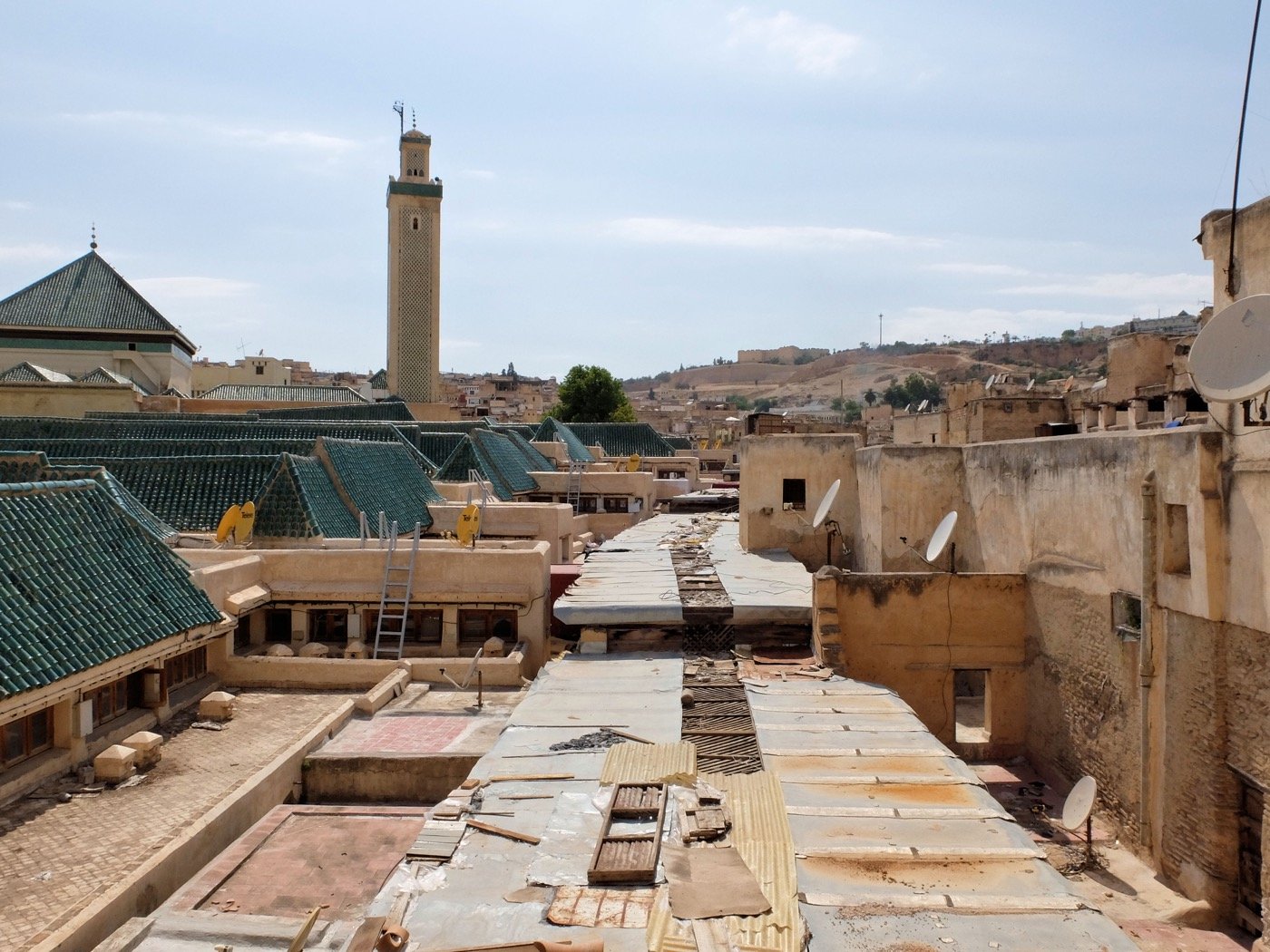
Fes is not a nightlife city, and that is part of its charm. Evenings here are about rooftop dinners, mint tea and the call to prayer over the rooftops. The Ville Nouvelle stays properly awake — Boulevard Mohammed V and Avenue Hassan II have cafés, ice cream, families and traffic until well after eleven. In the medina, the upper Talaa Kebira near Bab Bou Jeloud, the Batha area and the restaurant streets stay lively and lit until around ten or eleven, and then the metal shutters come down and the change is abrupt.
That shift is the single thing to plan around. A lane that was a wall of colour and noise at seven is a stone corridor with one bulb at eleven. Nothing is likely to happen to you in it — but you will not enjoy it, and you may not find your door. So the rule is simple: walk out, taxi back. Have dinner where you can leave by a gate, and take a red taxi to Batha, R’cif or the gate nearest your riad rather than crossing the medina on foot in the dark.
If you are out late, tell your riad roughly when you are coming back — most will meet you at the gate if you call, and many expect to. Our app’s Check-on-Me timer does the same job for the people at home: set it before dinner, and if you do not check in, your Safety Circle is told where you were. During Ramadan the whole rhythm inverts: the medina is quiet in the afternoon and then alive and joyful long past midnight after iftar, which is one of the best times to be here.
Solo travellers, and solo women
Fes is a good solo city. It is compact, people are hospitable in a way that is genuinely not transactional once you are off the main tourist artery, and riads are small enough that the staff learn your name by day two. The honest caveat is attention. Solo women should expect comments, “where are you from”, occasional following for a street or two, and a persistence in the medina that visitors from northern Europe or North America find wearing. It is overwhelmingly verbal, it rarely escalates, and it is not a reason to skip Fes.
What actually works, according to the women who travel here and the ones who live here:
- Do not engage. Every reply, even an annoyed one, is read as an opening. A flat “la, shukran” without breaking stride ends nine conversations in ten.
- Walk like you have somewhere to be. Standing still with a map in your hand is the single strongest signal that you can be approached. Step into a shop or café to check directions instead.
- Dress does not obligate you, but it does change the volume. Shoulders and knees covered draws noticeably less comment, and light long sleeves are more comfortable in a Fes summer anyway.
- Choose cafés with mixed clientele. Many traditional pavement cafés are all-male by long habit. You will not be thrown out, but the Ville Nouvelle cafés, medina rooftops and riad terraces are more relaxed.
- Book a riad rather than a big hotel for a late arrival, and give them your flight or train time. They will send someone to the gate.
- Use a guide for the first morning. A licensed guide for a half-day through your riad ends the faux-guide approaches for the rest of the week, because you will have been seen with one.
Our full guide on Morocco for solo female travellers goes deeper on this, including what to do if someone will not take no for an answer. The short version: step into a shop, and say so out loud. Shopkeepers in Fes take this seriously and will see the person off.
Things not to do
- Do not follow anyone down a lane you did not choose, however friendly the offer, and however short “just here, two minutes” sounds.
- Do not accept a “free” anything — henna, mint, a rooftop, a tea in a carpet shop — without settling first what happens at the end.
- Do not get into a petit taxi without agreeing the meter, and do not argue about a fare after the ride; agree it before.
- Do not carry your passport around the medina. Leave it in the riad safe and carry a photo of it on your phone.
- Do not photograph people — especially the tannery workers, market vendors and women — without asking. It is the fastest way to a real argument in Fes.
- Do not attempt to enter working mosques, including the Qarawiyyin, as a non-Muslim. Anyone offering to get you in is selling you something that is not theirs to sell. The Bou Inania and Al-Attarine medersas are open, ticketed and spectacular.
- Do not go anywhere near drugs, including hashish offered casually in the medina. Penalties in Morocco are serious and the offer is sometimes the setup.
- Do not walk the medina after dark on your last night with a full backpack and an early flight. Taxi.
Emergency numbers, and what to do
Save these three now, before you fly. They work from any Moroccan number, and Morocco’s emergency lines are answered in Arabic and French — so keep it to the essentials: your location, what happened, how many people.
Inside Fes you want 19. On the road out to Ifrane, Sefrou or the Middle Atlas, where the Gendarmerie Royale polices the highways, you want 177. Full detail and the rest of the list is on our page of emergency numbers in Morocco. Fes also has a tourist police brigade for anything involving a guide, a shop or a taxi dispute — your riad will point you to the nearest post, and a receipt or a photo helps enormously.
For medical care, the main referral hospital is the CHU Hassan II university hospital, with Hôpital Al Ghassani as the other large public option and Hôpital Omar Drissi near Batha as the closest to the medina. Private clinics in the Ville Nouvelle are quick for anything minor and expect payment or an insurance guarantee up front — travel insurance is something you buy separately, so do buy it. We have mapped the same thing for the country’s other big destinations, for example the best hospitals in Marrakech for tourists, and our free app carries a directory of 172 hospitals across 31 cities that works offline once installed.
If something does go wrong, the sequence is: get somewhere with people — a shop, a café, a riad — then call, then tell someone at home. Our one-tap SOS does the middle two at once: it dials the right Moroccan number for where you are standing, logs your GPS and sends it to your Safety Circle. Nobody at Stay Safe Morocco is dispatched to you; the call goes to Morocco’s own emergency services, which is exactly where it should go, and the people who love you know where you are while it happens.
The bottom line
Is Fes safe? Yes — and more than that, it is one of the most rewarding cities you will ever walk into, precisely because it has not been smoothed out for visitors. The medina will confuse you, someone will try to sell you a rug, and you will get lost at least once. None of that is danger. It is the texture of a living thousand-year-old city, and by day three you will be navigating it by the smell of the spice stalls.
Do three things before you arrive and the rest takes care of itself: book somewhere near Batha or the upper Talaa, get your phone connected with a Morocco eSIM so you land already online, and save 19, 15 and 177. Then go and get lost on purpose, with a taxi ride home in your back pocket.
Frequently asked questions
Is Fes safe for tourists in 2026? Yes. Violent crime against visitors is rare and the practical risks are commercial — fake guides, inflated fares, pressure selling. Standard city sense, a working phone and a taxi home after dark cover almost all of it.
Is the Fes medina safe to walk at night? The main lit arteries near Bab Bou Jeloud, Batha and the restaurant streets are fine until around ten or eleven. Once the shutters come down the side derbs go dark and empty, so take a taxi to the gate nearest your riad rather than crossing the medina on foot.
Which neighbourhood should I stay in in Fes? Batha or Ziat for a first visit — riads, atmosphere and a road where taxis can drop you. The upper Talaa Kebira and the quiet derbs of Douh and Guerniz are also excellent. The Ville Nouvelle around Boulevard Mohammed V is the easy, well-lit alternative.
Are fake guides in Fes still a problem? They persist, especially around Bab Bou Jeloud and the tannery, though unlicensed guiding is illegal and enforcement has tightened. Booking a licensed guide through your riad for the first morning removes the issue for the rest of your stay.
Is Fes safe for solo female travellers? Yes, with the honest caveat that comments and persistent attention are common in the medina. It is overwhelmingly verbal. Not engaging, walking with purpose, dressing moderately and taxis after dark are what experienced solo women here rely on.
What emergency number do I call in Fes? Dial 19 for police inside the city, 15 for an ambulance, and 177 for the Gendarmerie Royale on roads outside the city. Save all three to your phone before you arrive.
Is Fes safer than Marrakech? They are different rather than ranked. Fes sees fewer tourists so the hustle is gentler and the city feels more local, but the medina is far harder to navigate and English is less widely spoken. Marrakech is more practised at tourism and easier to move around, with more of the associated hard sell.
We are the team behind Stay Safe Morocco, the free iOS safety app for visitors to Morocco. We built the one-tap SOS that dials Morocco’s real emergency numbers, the directory of 172 hospitals across 31 cities, and the Safety Circle that receives your location the moment you press SOS. We live and work here, and we keep this guide current.
🛡 Land in Morocco already connected — and safe
Every StaySafe Morocco eSIM comes with free Family SOS: one tap to reach emergency help and share your live location with your family. No data cap, keep your number, from $12.50.
Get your eSIM + Family SOS →Explore Morocco — city guides
- Agadir
- Best Places to Visit in Morocco: A First-Timer’s Shortlist
- Best Things to Do in Marrakech: The Essential Guide
- Casablanca
- Chefchaouen
- El Jadida
- Essaouira Culture Guide: Gnaoua Music, Art & Local Life
- Essaouira
- Fes
- Marrakech in Summer: Pools, Heat & How to Stay Cool
- Marrakech
- Meknes
- Nador
- Ouarzazate
- Oujda
- Places to Visit in Marrakech: A First-Timer’s Day-by-Day Map
- Rabat
- Safi
- Tangier
- Tétouan