Rester connecté au Maroc est plus facile que la plupart des nouveaux visiteurs ne l'imaginent. Vous pouvez obtenir une carte SIM locale avec un généreux volume de données pour moins de 10 €, et cela simplifie énormément la navigation, la communication et votre sécurité. Voici tout ce que vous devez savoir.
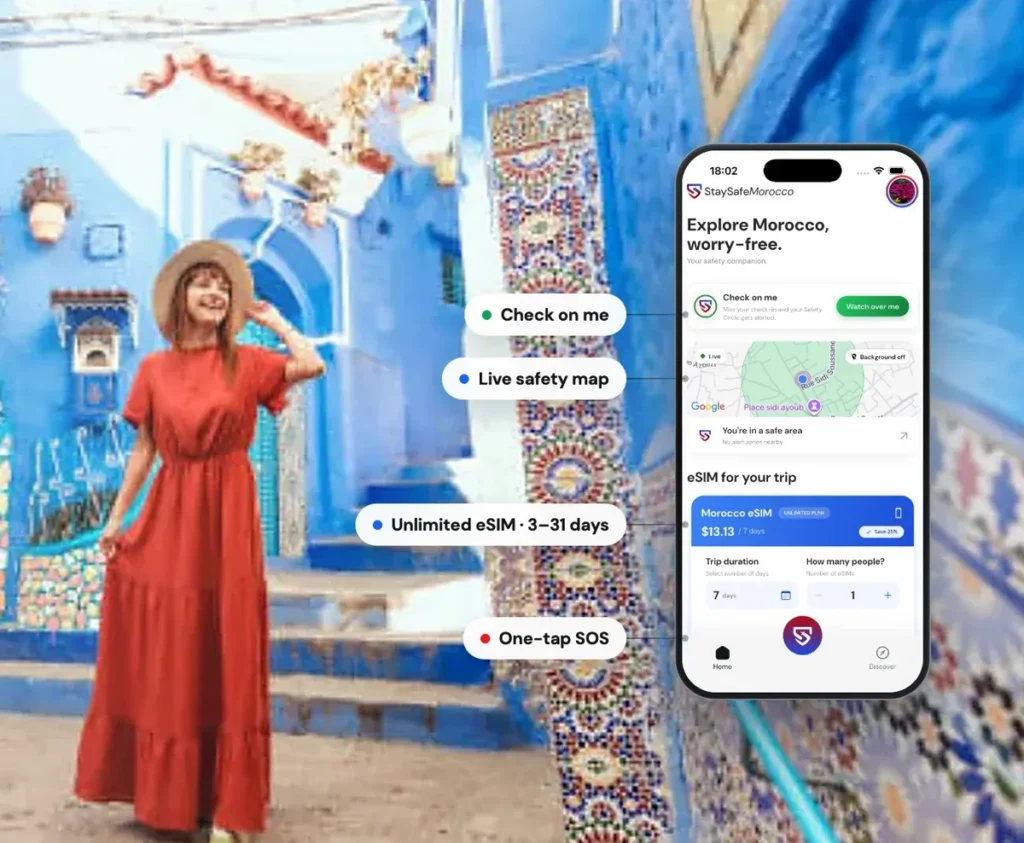
Si vous voulez éviter toute complication, procurez-vous une eSIM marocaine avant votre vol. Activez-la instantanément, sans file d'attente ni carte physique : juste des données dès l'instant où vous atterrissez. L'application StaySafe Morocco propose des forfaits eSIM à partir de quelques euros seulement.
Les principaux opérateurs mobiles du Maroc
Le Maroc compte trois grands réseaux, tous avec une bonne couverture dans les villes et sur les principaux itinéraires touristiques :
Le plus grand réseau, avec la meilleure couverture rurale et en montagne. Le meilleur choix si vous vous dirigez vers les montagnes de l'Atlas, le Sahara ou de petites villes.
Excellente 4G dans les villes. De bons forfaits de données et un bon service client dans les zones touristiques. Le personnel des grandes boutiques parle souvent français et parfois anglais.
Souvent les forfaits de données les moins chers. Idéal pour les voyageurs à petit budget qui restent dans les villes. Un peu plus faible dans les zones reculées.
Où acheter une carte SIM
Boutiques officielles des opérateurs
L'option la plus sûre et la plus simple. Vous trouverez des boutiques officielles Maroc Telecom, Orange et Inwi à :
- Aéroport Marrakech-Ménara (hall des arrivées, ouvert pour la plupart des vols)
- Gueliz (ville nouvelle) : plusieurs boutiques sur l'avenue Mohammed V
- Dans les supermarchés Marjane et Carrefour
- La plupart des centres commerciaux du centre-ville
Revendeurs agréés
Les petits bureaux de tabac et épiceries de quartier de toute la médina vendent des cartes SIM et des recharges. Un peu moins fiables pour l'enregistrement, mais pratiques. Les prix devraient être les mêmes que dans les boutiques officielles.
Des personnes à l'extérieur du hall des arrivées peuvent vous aborder pour vous proposer des cartes SIM. Elles sont généralement trop chères et peuvent ne pas être correctement enregistrées. Utilisez plutôt les kiosques officiels à l'intérieur du terminal.
Ce dont vous avez besoin pour acheter une carte SIM
Depuis 2018, le Maroc exige l'enregistrement avec passeport pour toutes les cartes SIM. Apportez votre passeport : une photo de celui-ci ne sera pas acceptée dans la plupart des boutiques. L'enregistrement est rapide (2 à 3 minutes) et votre SIM est généralement active en moins de 30 minutes.
Forfaits de données recommandés (2025)
- 1 Go / 7 jours — environ 30 à 40 MAD (3 à 4 €)
- 5 Go / 30 jours — environ 79 à 99 MAD (7 à 9 €)
- 10 Go / 30 jours — environ 149 MAD (13 à 14 €)
Achetez du crédit de recharge dans n'importe quel bureau de tabac, station-service ou supermarché. Donnez simplement au caissier le numéro et le montant : il recharge votre solde directement.
eSIM : l'option la plus simple
Si votre téléphone prend en charge l'eSIM (c'est le cas de la plupart des téléphones fabriqués après 2020), obtenir une eSIM marocaine avant de partir de chez vous signifie que vous arrivez connecté, sans aucune file d'attente. Vous l'installez comme une application : scannez un QR code, activez, et c'est fait.
Allez dans Réglages → Données mobiles → Ajouter un forfait. Si vous voyez cette option, votre téléphone est compatible eSIM.
Achetez une eSIM marocaine via l'application ou le site web de StaySafe Morocco. Vous recevrez un QR code par e-mail en quelques minutes.
Scannez le QR code à votre atterrissage. Votre forfait de données démarre immédiatement. Pas de file d'attente, pas d'enregistrement de passeport requis.
Comme l'eSIM est une seconde ligne, votre numéro d'origine reste actif pour les appels et les SMS de validation en deux étapes : parfait pour les applications bancaires qui envoient des codes par SMS.
Une eSIM vous permet de descendre de l'avion déjà connecté : idéal pour appeler le taxi de votre hôtel ou utiliser Google Maps immédiatement.
Wi-Fi au Maroc
Le Wi-Fi est disponible dans la plupart des riads, hôtels et cafés des zones touristiques. La vitesse est variable. Ne comptez pas dessus pour la navigation ou les appels d'urgence. Une SIM de données reste la solution de secours la plus sûre.
Si vous faites de la randonnée dans le Haut Atlas ou que vous partez vers le Sahara, téléchargez des cartes hors ligne (Google Maps ou Maps.me) avant de partir. Même les meilleurs réseaux marocains ont des zones blanches en terrain montagneux.
L'application StaySafe Morocco inclut des forfaits eSIM, un localisateur d'hôpitaux et de pharmacies hors ligne, et des numéros d'urgence, le tout au même endroit. Téléchargez-la avant votre voyage pour une tranquillité d'esprit totale.
Prêt à vous connecter au Maroc ?
No data cap from $2.79 a day — choose 7 to 31 days, get your QR code by email, and the free StaySafe safety app comes with every eSIM.
Voir les forfaits eSIM Maroc →Explorer le Maroc — guides des villes
- Agadir
- Les plus beaux endroits à visiter au Maroc : la sélection idéale pour un premier voyage
- Les meilleures choses à faire à Marrakech : le guide essentiel
- Casablanca
- Chefchaouen
- El Jadida
- Guide culturel d'Essaouira : musique gnaoua, art et vie locale
- Essaouira
- Fes
- Marrakech en été : piscines, chaleur et comment rester au frais
- Marrakech
- Meknes
- Nador
- Ouarzazate
- Oujda
- Lieux à visiter à Marrakech : le programme jour par jour du primo-visiteur
- Rabat
- Safi
- Tanger
- Tétouan