If you’re comparing Morocco eSIM prices and every plan is starting to look the same, here is the short answer: a fairly priced travel eSIM for Morocco should scale with your trip, not punish you for how long you’re staying. Our plan starts from $12.50, includes no data cap and two hours of calls, and the per-day rate drops the longer you stay — down to around $1.30 a day on longer trips. Anything that charges you the same whether your trip is three days or three weeks, or that sells you a fixed data allowance you have to ration, is priced for someone else’s convenience rather than yours.
This guide is the arithmetic nobody puts on a pricing page: how to compare the four ways of getting online in Morocco on equal terms, how the per-day rate actually works as your trip gets longer, the small print that quietly moves the price after you’ve paid, and what a connection is really for once you’ve landed. If you’re still deciding what to buy rather than what it should cost, our Morocco eSIM buying guide covers the choice itself.
Ignore the sticker price. Divide by days.
The number on the button — $13, $20, $30 — tells you almost nothing on its own, because every provider structures its plan differently: some charge by the gigabyte, some by the day, some bill your card daily whether you’re online or not. The only figure that lets you compare plans honestly is price divided by the number of days you’re actually travelling, and it takes five seconds on your phone’s calculator.
Run it on everything you’re looking at, ours included. Our plan works out to about $1.30 a day once you’re travelling for three weeks or more, and starts from $12.50 for a short trip — with no data allowance to run out partway through, so the day rate is the whole story, not a starting point that gets more expensive once you hit a cap. A plan that charges you per gigabyte instead can look cheap on the button and then bill you again the moment maps, photos and a video call add up.
It’s also why “price divided by gigabytes” is the wrong question for a plan like ours: there’s no gigabyte ceiling to divide by. What actually moves the price is how many days you’re away, so that’s the only number worth comparing.
The four things you're really comparing
“Morocco eSIM price” only means something next to the alternatives. There are four realistic ways to have working data in Morocco, and they fail and succeed in different places — cost, time, and whether your own phone number keeps working.
The most expensive option almost every time. Commonly around $10–$12 per day with US carriers; European plans usually drop out of “roam like at home” at the Moroccan border and charge out-of-bundle rates. You pay per day, not per gigabyte.
Reasonably priced per gigabyte, but it costs you a queue, your passport details, a SIM tray tool and — the part people forget — your own number, which is where your bank codes and WhatsApp verification arrive.
Installed at home, live the moment you land, home number still in the phone alongside it. Price varies enormously between providers, which is exactly why the per-day division matters.
Free, and genuinely fine in a riad in the evening. It is not a plan for the taxi from the airport, the walk into the medina, or the moment you want a map on a street with no signage.
New to the format itself? Here’s what an eSIM is in plain terms — it’s a SIM your phone downloads rather than one you slot in, and any phone from roughly the last five or six years supports it.
Day passes charge you for the days you barely use
A daily roaming pass has one honest advantage — you do nothing before you fly — and one structural flaw: it bills the calendar, not your usage. Twelve days in Morocco at around $12 a day is roughly $144, and you pay full price for the day you spent on the Marrakech–Tangier train reading a book, and for the day in the dunes where you had no signal to spend anyway.
Compare that to a plan that already works out to well under $2 a day at that length and sits there quietly for the whole trip. On a two-week holiday the gap is typically well over a hundred dollars — real money, roughly a night in a good riad, or a proper dinner for two overlooking the Atlantic in Essaouira.
There’s a subtler cost too. Because day passes feel expensive, people ration them: aeroplane mode on, data off, “I’ll check when we get to the hotel”. Rationing your connection is the opposite of what a connection is for.
Airport SIM counters: fair price, awkward morning
Morocco’s operators sell tourist SIMs at the airport and the per-gigabyte rate is genuinely competitive — nobody is being fleeced. The cost lands somewhere other than the receipt.
You queue after a flight, hand over your passport, wait for registration, find something to pop the tray with, and put your home SIM somewhere you will definitely remember. Then your own number is offline for the trip, which matters more than it sounds: that’s the number your bank texts a code to and the number WhatsApp verifies against if you’re ever logged out. Our guide to getting a SIM card in Morocco as a tourist walks the process properly if you’d rather do it that way.
The honest comparison isn’t “eSIM versus SIM on price”. It’s whether you’d rather arrive already connected, or spend the first forty minutes of your holiday arranging to be.
What actually moves the price (hint: it's not gigabytes)
With a capped plan, half the work is guessing right: buy too little data and you’re rationing maps in the medina; buy too much and you’ve paid for headroom you never touched. Our plan removes that guess entirely — there’s no data ceiling, so streaming, video calls and a hundred photos a day cost exactly the same as barely using your phone at all. The only number that changes your price is how many days you’re travelling.
That makes the sizing question simple: match the day count to your actual itinerary, not to a data estimate.
A long weekend or a one-city stay. Starts from $12.50, with nothing to ration.
The most common Morocco itinerary. The per-day rate is already easing off at this length — a full week is $13.13, working out to under $2 a day.
Long stays and multi-city tours get the steepest discount — the per-day rate keeps falling to around $1.30 a day, so a full 31-day plan is $40.30.
If you’re unsure, round up rather than down: an extra day or two costs about a dollar at the long-trip rate, and it’s cheaper than the alternative — landing on the last day of a plan that’s about to expire while you’re still in the country.
Five ways a cheap eSIM stops being cheap
Some plans begin their validity window the moment you pay, not the moment you land. Buy on Monday, fly on Friday, and you’ve donated four days.
A “no data cap” claim usually means full speed to a threshold, then throttled to something that struggles with a map tile. Read for the number of gigabytes before the slowdown — that’s the plan’s real size.
Running out mid-trip is where margins live. Check the top-up rate before you buy, not after — or pick a plan with no cap to begin with, so there’s nothing to run out of.
Plenty of travel eSIMs sell data alone. It’s fine until a Moroccan number needs calling back and you have no way to place the call.
The cheapest plan with no support is expensive the night the QR code won’t scan. If something does go sideways, our fixes for a Morocco eSIM that isn’t working solve most cases in a couple of minutes.

What you're buying isn't gigabytes
Here’s the thing no price table can show. Data is the unit of sale, but it isn’t the point. The point is that when you take a wrong turn in the Fes medina — and you will, everyone does, it’s half the pleasure — you can pull up a map, message the riad, and get on with your afternoon.
That’s why we price for the whole trip rather than the gigabyte. A connection you’re mentally rationing isn’t doing its job. One that just works from touchdown lets you say yes to the detour, the extra night in Chefchaouen, the last-minute train to Rabat.
Install it before you fly — it takes about two minutes, and our phone setup checklist covers the rest of the pre-flight admin — then land, switch it on, and start your holiday in the arrivals hall instead of in a queue.
The numbers that cost nothing at all
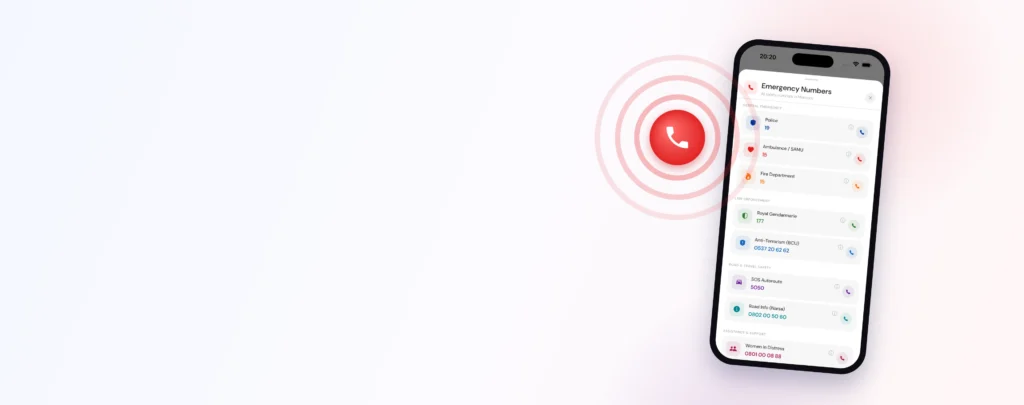
Worth knowing regardless of which plan you buy: Morocco’s emergency numbers work from any phone, including one with no SIM, no credit and no data. Save them anyway — the Stay Safe Morocco app keeps them one tap away, works offline, and its SOS screen dials the local number while logging your location so you can read it out or show it.
Morocco is a confident, welcoming country to travel in, and the vast majority of visitors never dial any of these — our full Morocco safety guide puts the picture in context. Knowing them is just part of arriving well prepared, like knowing which taxi is petit and which is grand.
Waar het op neerkomt
Do the division. A Morocco eSIM priced honestly scales with your trip, not against it — our plan starts from $12.50, drops to around $1.30 a day the longer you stay, includes two hours of calls, and never bills you again for going over a data limit that doesn’t exist. Match the day count to your trip, install it at home, and land connected.
Then forget about it entirely. The best thing a well-priced eSIM does is stop being something you think about, so the only decisions left are which medina to get lost in and how many glasses of mint tea is too many.
Veelgestelde vragen
How much does a Morocco eSIM cost? Our Morocco eSIM starts from $12.50 for a short trip, and the per-day rate drops the longer you stay — down to around $1.30 a day on trips of three weeks or more, so a full 31-day plan is $40.30. Every plan includes two hours of calls as well as data with no cap.
Is an eSIM cheaper than roaming in Morocco? Almost always, and the gap widens with every day you stay. Home-carrier day passes commonly run around $10–$12 per day, so a twelve-day trip can reach roughly $144, versus a single StaySafe plan for the whole stay that works out to well under $2 a day at that length. Day passes bill the calendar regardless of use; our plan just bills the days you’re actually travelling.
Is a SIM card from the airport cheaper than an eSIM? Moroccan operators’ tourist SIMs are competitively priced per gigabyte, so the difference is rarely dramatic. The real cost is the arrivals queue, passport registration, and swapping out your home SIM — which takes your own number offline just when your bank might text you a code.
Do I need to choose how much data I get? No — every StaySafe Morocco plan includes data with no cap, so there’s nothing to ration or run out of. The only thing you choose is how many days you need, from 5 to 31.
Can I make phone calls on a Morocco eSIM? Yes — two hours of calling time are included in every plan, unlike many travel eSIMs that sell data only. It’s there for the calls apps can’t handle: ringing your riad, a taxi office, or a museum to check opening hours.
🛡 Land in Marokko al online — en veilig
Bij elke StaySafe Morocco eSIM krijg je gratis Family SOS: one tap to reach emergency help and share your live location with your family. No data cap, keep your number, from $20.79.
Haal je eSIM + Family SOS →Before you go — related guides
- Is Morocco safe for tourists?
- Emergency numbers in Morocco
- Common scams in Morocco & how to avoid them
- How to get internet & mobile data in Morocco
- How to get a SIM / eSIM in Morocco
- Best eSIM for Morocco: plans & prices
- Buy a Morocco eSIM — no data cap, your dates
- Morocco eSIM setup: device check & activation
- What is an eSIM and how does it work?
Explore Morocco — city guides
- Agadir
- Best Places to Visit in Morocco: A First-Timer’s Shortlist
- Best Things to Do in Marrakech: The Essential Guide
- Casablanca
- Chefchaouen
- El Jadida
- Essaouira Culture Guide: Gnaoua Music, Art & Local Life
- Essaouira
- Fes
- Marrakech in Summer: Pools, Heat & How to Stay Cool
- Marrakech
- Meknes
- Nador
- Ouarzazate
- Oujda
- Places to Visit in Marrakech: A First-Timer’s Day-by-Day Map
- Rabat
- Safi
- Tangier
- Tétouan